
Dispelling Cry-It-Out Sleep Training Myths and What to Do Instead: A New Academic Anthology

Darcia Narvaez, PhD, Kindred World’s president, and Mary Tarsha, KW board member, have contributed a chapter to the forthcoming book, Dispelling Cry-It-Out Sleep Training Myths and What to Do Instead. Narvaez’s and Tarsha’s chapter is entitled, The Evolved Nest: Sleep Training Violates Humanity’s Baselines for Child Raising.
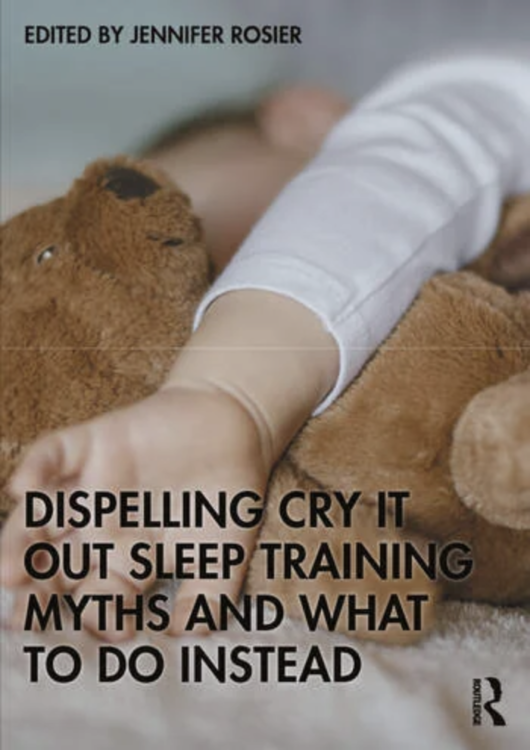
Contributing editors to the book include: Jennifer G. Rosier, Tracy G. Cassels, Kathleen Kendall-Tackett, Elaine S. Barry, Levita D’Souza. The editor is Jennifer G. Rosier, Ph.D., a Professor of Interpersonal Communication at James Madison University. Her research interests center around understanding the innerworkings and interdependence of romantic and parent–child relationships. She has published several articles about the cry‑it‑out method in journals such as theJournal of Family Issues, Clinical Lactation, and Family Science Review.
This guide draws together evidence from psychology, neuroscience, anthropology, and human development to make a compelling case for why you shouldn’t be using or recommending crying-it-out sleep training techniques with babies.
Dispelling Cry-It-Out Sleep Training Myths and What to Do Instead explains what normal infant sleep is like and explores the history and context of cry-it-out sleep training methods for infant sleep. It presents what research shows us about the impact of cry-it-out on babies’ wellbeing and on attachment with their caregivers. It investigates how brain development is affected by sleeping training and discusses why sleep training is developmentally inappropriate and often does not work. The book ends with an in-depth exploration of alternative approaches to promoting good quality infant sleep.
This informative guide is designed to support health, social work, and education professionals working with families and young children.
About Darcia Narvaez’s Contribution to Dispelling Cry It Out Sleep training Myths and What To Do Instead
Narvaez, D., & Tarsha, M. (in press). The Evolved Nest: Sleep training violates baselines for child raising. In J. Rosier (Ed.) Enough (Crying) Already. Routledge.
Abstract
Over 99% of human existence and among preconquest cultures worldwide, humanity’s communal evolved nest was provided to the young, ensuring good health and a cooperative nature. Because of their vast immaturity, babies need an “external womb” experience to develop properly. Supportive, calming care is characteristic of our ancestral practices, where babies are rarely alone, rarely cry and are quickly comforted. In recent years, science has been able to demonstrate that children’s experience in early life shapes the functioning of multiple physiological (e.g., stress response) and psychological (e.g., sociality) systems. Supportive care shapes healthy parameters, thresholds and trajectory for every major physiological system. Children’s brains and bodies are co-constructed by caregivers, learning self-control from soothing care. Sleep training violates humanity’s evolved nest with its separation, nonresponsiveness, lack of touch, imposition of distress and non-stimulation. Babies need instead companionship, responsiveness, nearly 24/7 affectionate touch, comforting presence and social stimulation.