
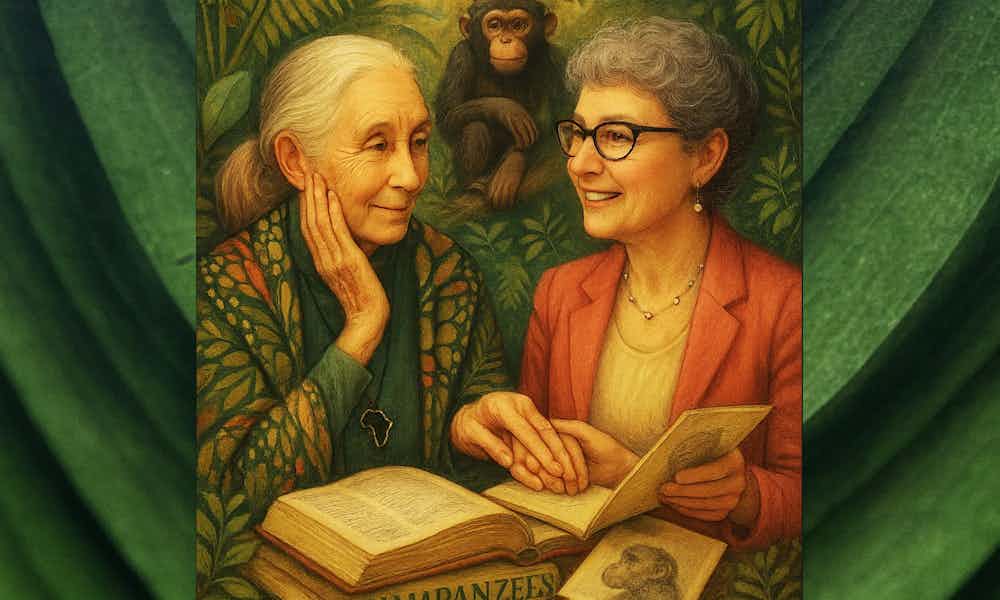
 Image by Dan Warren
Who Will Be Our Jane Goodall?

 Editor’s Note: Below is an excerpt from Amy Warren’s new article featured in Resurgence & Ecologist’s Radical Hope special issue (Issue 355 • March/April 2026). You can read more about Kindred’s tribute to Jane Goodall, who passed earlier this year, here. Learn more about Darcia Narvaez and the Evolved Nest here. Become a Nesting Ambassador and join an international cohort in studying the science of the Evolved Nest.
Who Will Be Our Jane Goodall?
Jane Goodall taught us what it means to protect a species by understanding its way of life. As we mourn her passing, we might ask: Who is doing the same for us? Who is conserving human wellbeing?
Goodall became renowned for her deep understanding and conservation of chimpanzee wellbeing, giving us a window into what is normal for their species and what’s at risk when that system breaks down. Like all animals, chimpanzees evolved a system for raising their young optimally, conserved over millions of years because it sustains survival.
Like chimpanzees, we too have a millions-year-old system. But unlike them, we’ve recently (within our human history) shifted away, coinciding with today’s profound challenges to human wellbeing. To conserve our own wellbeing, we must look into a mirror.
A Mirror for Our Species
One person comes to mind: Darcia Narvaez, Professor Emerita of Psychology at Notre Dame, the co-founder of the Nested World Initiative, and Kindred World’s president. Her research helps humans restore their evolved system, the ancestral wisdom for becoming fully human. If Goodall gave us a window into chimpanzee life, Narvaez offers us a mirror, revealing what’s normal for our species and how far we’ve drifted:
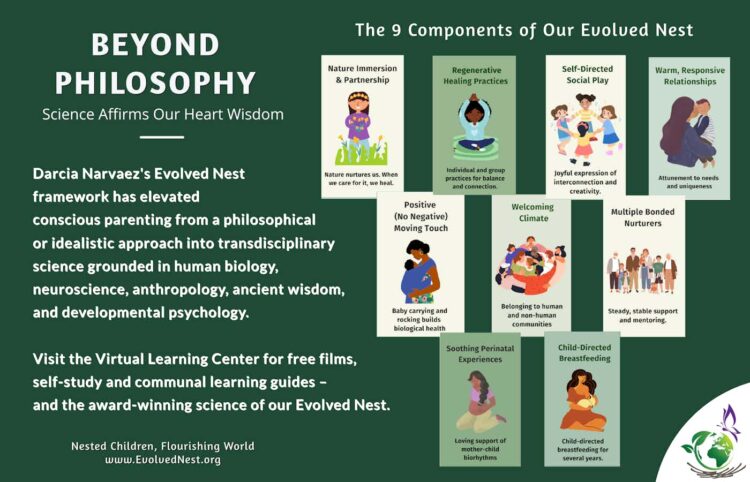 The “Evolved Nest,” 9 things humans need to thrive:
Welcoming social climate
Soothing perinatal experiences
Breastfeeding
Positive touch
Stable responsive care
Self-directed social play
Multiple alloparents
Nature connection
Restorative practices
For most of human history these defined us. Modern cultures, especially in the West, have shifted away: more medicalized births, less breastfeeding support, smaller and busier families, less time in nature, more structured schedules. Culture changes in decades; our biology takes millennia. Closing this gap is urgent.
Just as Goodall showed us how to conserve chimpanzee wellbeing, Narvaez shows us how to return to our human baseline. Looking through a window may be easier than looking into a mirror. Will we yield to what we see?
As we honor Jane Goodall’s legacy, may we also answer the call to conserve our own species’ wellbeing with as much vigor as we have given to chimpanzees. The conservation of human wellbeing is not optional; it is our shared future.