
Integrating Evolved Nest Science Into Nature and Art Therapy, with Kathrine Cays
A Nesting Ambassador Praxis Presentation
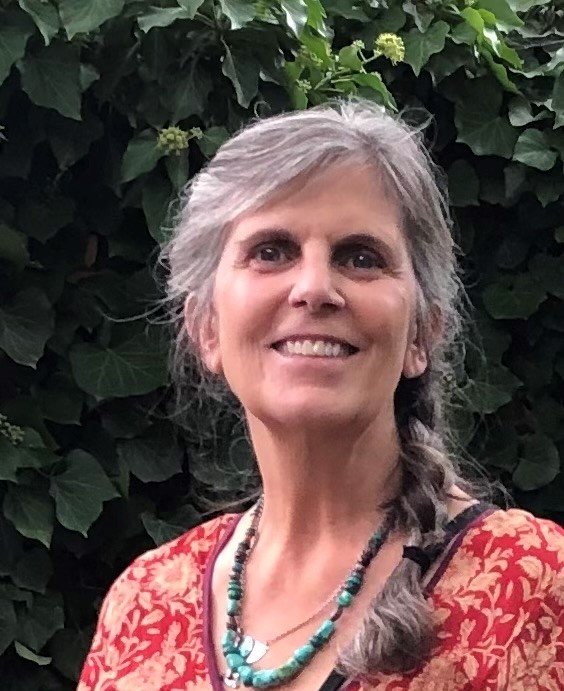
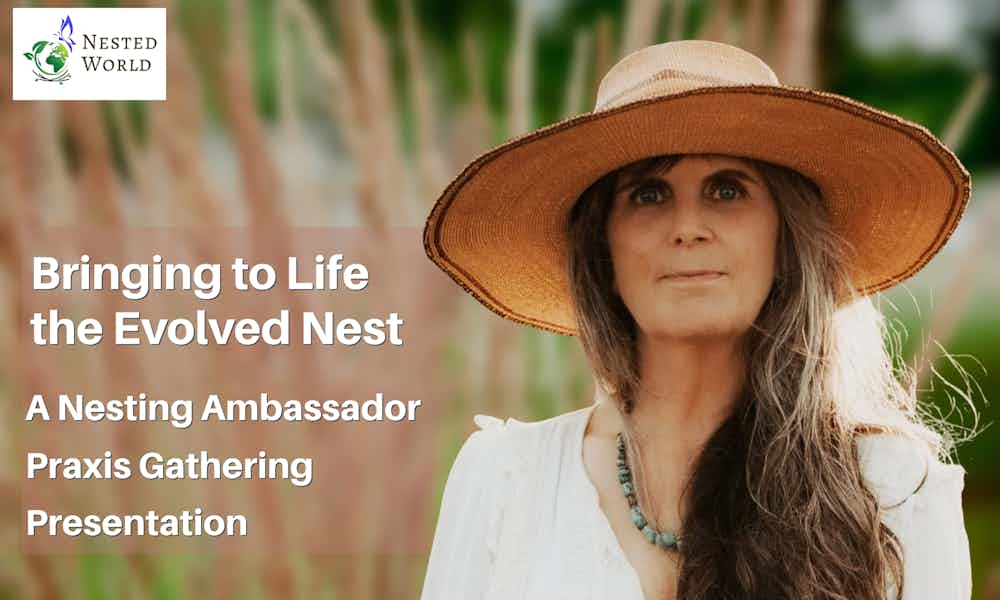
The video below is a presentation by Kathrine Cays, a Certified Nesting Ambassador ’25, to the current cohort in-training. If you are interested in exploring the Nested World Initiative or becoming a Nesting Ambassador, visit www.NestedWorld.org.
Kathrine’s Presentation Script
Slide 1) Thank you so much to Darcia and Lisa for inviting me to visit with you all today I want to firstly honor the work that Darcia and Lisa are doing here and all the ways that they are touching others in the community, and I want to honor you nesting ambassadors for the work that you are doing and the work that you’ve already done, the learning and unlearning… may Love hold you in all of your ways.
 Slide 2) I come to you as a grandmother, artist, poet, and nature‑assisted expressive arts therapist of Galic Irish descent living in Hampstead, in what is currently called Pender County, North Carolina, on the traditional homelands of Indigenous peoples, including the Cape Fear Indians and other Siouan-speaking nations of the lower Cape Fear. My presence here, as a resident who recently moved to be near family and as a doctoral student, depends on land taken through colonization and ongoing structures of settler colonialism, which I understand as obligating me to honor and engage Indigenous scholarship alongside decolonial, reparative practices. My name is Kathrine Cays.
Slide 3) I understand the Evolved Nest as a caregiving environment that, Darcia explains, is an extra-genetic inheritance. What I understand is that, in addition to classical genetic inheritance through our parents, we also inherit through other channels that influence how those genes are used or how we grow up and learn. This is what gets transmitted culturally, socially, and environmentally. It starts when we are born but evolves across the lifespan.
I root my work as a nature-assisted expressive arts therapist in the understanding that humans are meant to grow within an Evolved Nest of relational, ecological, and communal care. I carry Darcia’s Evolved Nest science and a kinship worldview not as theories on the side, but as the ground of how I live, how I shape relationships, and imagine what healing can be.
Slide 4) In my practice as a therapist, every session begins with a welcoming social climate with the question: “What kind of nest will we co-create here, right now?” I invite the land, the more-than-human community, and the client to co-author that answer. I invite people into gentle arrivals—breath, sensory attunement, and presence—so their nervous systems can cross the threshold slowly, rather than being dropped into “doing therapy.” This arrival is a kind of rebirth. We let the body show us what it needs, and we let the land be the first voice we listen to.
I understand multiple nurturers very literally. I am one caregiver in the room, but not the only one. Trees, birds, stones, wind, sunlight, water, and ancestors also hold the space. I speak about them as active relatives, not scenery. When a client leans against a tree, cradles a stone in their palm, or walks barefoot on sand, I invite them to notice how their body responds with that contact and what quality of care is being offered. In this way, touch becomes safe, consensual contact with earth and elements, rather than exclusively human-to-human. The “holding” is shared.
Responsivity, or the responsive relationship, is central to how I move in my work. And this becomes a pattern that my clients can adapt to their own daily lives, beginning with their relations with themselves and moving out to loved ones and community. This is a practice of listening, to be open to noticing subtle shifts in breath, posture, eye contact, and tone, so we can learn to adjust pacing accordingly. If our systems begin to tighten, we might consciously invite the breath to calm the sympathetic nervous system (“fight-or-flight”) via the vagus nerve, reducing stress hormones and influencing emotional processing (DISalvo, 2017). If curiosity and play start to emerge, we widen the invitation —more movement, more space to explore. I invite clients to choose whether they sit, stand, walk, draw, assemble, or rest, and for how long. I see this as a parallel to child-directed breastfeeding, where the body’s own signals guide the rhythm of nourishment.
In my work, Play and Creativity are not extra, they are the medicine. I co-create conditions not only for curiosity and creativity but also for communion using simple materials mindfully gathered from Nature and around the home. Clients may draw, build temporary altars, land sculptures, or improvise movement and sound in conversation with wind or tide. I name the difference between this artmaking process and productivity culture: the art does not have to be “good,” kept, or justified. It only has to be honest. This playful, low-stakes making is one way I counter internalized colonial messages about worth, speed, and control.
Slide 5) Nature immersion is the backbone of my work. When I meet with someone outdoors, or bring the outdoors into indoor spaces through materials and ritual, I invite the more-than-human world as a co-therapist. We might spend ten minutes simply tracking the movement of clouds or the pattern of rippling water before we ever touch art materials. I often ask: “If this land could speak your language and tell you about what you are carrying, what might the Land say?” This kind of questioning invites people into a kinship stance where the more-than-human world is a knowing, sentient relative, not an inert backdrop.
Neurodecolonization (Yellow Bird, n.d.) shapes the way I structure sessions. I explicitly name and gently interrupt colonial habits of speed, perfectionism, disconnection from the body, and extraction from the living world. We might begin by noticing internal dialogues like “don’t waste time,” “don’t make a mess,” “this isn’t important,” and then interrupt and replace them. We slow down. We leave more than we take. We make “unfinished” art and let it be enough; we invite compassion and kindness. We listen longer than feels comfortable. In this way, the nervous system rehearses different patterns: safety in slowness, dignity in rest, belonging in relationship with more-than-human kin.
I anchor my practice in Indigenous relational ethics as I’ve been taught, ethics as an accountable, reciprocal relationship with land, ancestors, community, and future generations. This means I do not see my work as only a service to individual clients. I understand each session as part of a wider project of re-nesting, helping restore patterns of care that extend out into families, communities, and ecosystems. In my work with others, with art, and with Nature, this looks like tending to how I show up in local ecologies, like my local community garden, how I honor lineages of knowledge in my research, and how I design offerings that invite people into mutual care rather than consumption.
Slide 6) Across all of this, I experience myself more as a host, supporting people in remembering how to feel held by the sentience of the living world as kin, how to listen to their own bodies as part of an earth body, and how to reclaim the relational capacities that the Evolved Nest describes as our birthright. When we begin to experience ourselves as necessary members of a living web rather than isolated individuals working on “problems,” our work, whatever that is, becomes a lived experience as intended from the beginning.
Part of my work is Meditation as Neuroplastic Activism for Decolonizing Consciousness
Slide 7) In my work across the lifespan nest that is the Evolved Nest (extending through adulthood), work within the ecological nest (cultivating relations with land and other-than-human kin), and what I think of as the “cosmic nest” (our cosmological and spiritual embeddedness). I have embraced authoring and sharing guided meditations.
Recent neuroscience reveals what Indigenous wisdom traditions have long known—that contemplative practices literally reorganize the brain, creating new pathways for understanding and creativity. It is like rearranging furniture in a room to open new flows of movement and light; in the same way, meditation induces measurable neuroplastic changes that can help break free from Eurocentric patterns of dominance.
In my practice of authoring Meditations, I use my Soft Voice as Decolonial Strength
In embracing my soft voice—what dominance culture dismisses as weakness—I’ve discovered what quiet leadership research now confirms: that listening over speaking, humility over certainty, and collaboration over competition aren’t “soft skills” but survival skills. Contemplative leaders who cultivate inner stillness create the space Viktor Frankl described as between stimulus and response, where we can choose responses aligned with wisdom rather than react from colonial conditioning. I encourage you all to lean into your gifts, too, no matter what others may say.
My guided meditations are not retreats from the world but active participation in what some scholars call “neurodecolonization,” the conscious practice of rewiring our brains away from the abstract, disconnected awareness imposed by colonization, and toward the embodied, relational consciousness that characterizes indigenous and pre-colonial ways of being by expanding emotional intelligence and imagination (Narvaez, 2014).
Returning to Nestedness Through Contemplation
The Evolved Nest framework reminds us that humans evolved within a “millions-year-old wellness-informed pathway of nestedness”—a web of responsive relationships with caregivers, community, land, and cosmos. Meditation practice helps restore this nestedness by:
- Reducing stress hormones that damage the hippocampus and prevent neuroplastic growth
- Strengthening interconnectivity between brain networks responsible for self-awareness, emotional regulation, and executive function
- Fostering the growth of new neural connections that support the receptive, relational intelligence our ancestors knew
When I record guided meditations in my naturally soft voice, I am offering an invitation to what contemplative practice scholar Murray Beasley suggests: “each time we engage in one or another form of [contemplative practice] … we are reconnecting to humanity’s pre-colonial consciousness”. We are literally helping our nervous systems remember kinship, remember nestedness, remember that we belong TO rather than dominate the living world.
This is neuroplastic activism. This is how we rearrange the colonial furniture that has cluttered our collective consciousness for more than 500 years. And this work, quiet, gentle, persistent, creates the neural foundations for the decolonial, regenerative futures we are called to build.
As we come to a pause after our exploration of my way of weaving an Evolved Nest, where we have been engaging with ideas, thinking together, tracing concepts, and expanding our cognitive understanding of how interbeing unfolds through relationship, care, and co-regulation.
Now, we’ll shift our attention from the mind’s way of knowing into the body’s, the heart’s, and the imagination’s. This next part invites us into a creative, contemplative space, a way of embodying the principles we’ve been considering.
Rather than analyzing connection, we’ll experience it. Through this guided meditation on Interbeingness with Nature, we’ll sense into our place within the web of life, allowing awareness to soften and expand beyond thought—into the felt reality of belonging.
You might allow your posture to settle, your breath to find its rhythm, and your inner attention to widen, gently meeting this practice with curiosity and openness.
References
Abram, D. (1996). The spell of the sensuous: Perception and language in a more-than-human world. Vintage Books.
Abram, D. (2010). Becoming animal: An earthly cosmology. Pantheon Books
DISalvo, D. (2017). How Breathing Calms Your Brain Research points to a wealth of ways controlled breathing benefits the brain
https://www.psychologytoday.com/us/blog/neuronarrative/201712/how-breathing-calms-your-brain
Ding, X., Tang, Y. Y., Cao, C., Deng, Y., Wang, Y., Xin, X., & Posner, M. I. (2015). Short-term meditation modulates brain activity of insight evoked with solution cue. Social cognitive and affective neuroscience, 10(1), 43–49. https://doi.org/10.1093/scan/nsu032
Santamecchi et al. (2014). Neurobiological Changes Induced by Mindfulness and Meditation. PMC. https://pmc.ncbi.nlm.nih.gov/articles/PMC11591838/
Mount Sinai (2025). New Research Reveals That Meditation Induces Changes in Deep Brain Areas Associated with Memory and Emotional Regulation.
Brewer et al. (2011). Meditation leads to reduced default mode network activity beyond an active task. PMC. https://pmc.ncbi.nlm.nih.gov/articles/PMC4529365/
Plasticity Centers (2025). Enhance Brain Function With Mindfulness and Neuroplasticity.
Short-term meditation modulates brain activity of insight. PMC. https://pmc.ncbi.nlm.nih.gov/articles/PMC4994853/
Beasley, M. (2024). Contemplative practice: enabling a decolonising experience. JUICE. https://juice-journal.com/2024/06/22/contemplative-practice-enabling-a-decolonising-experience/
Narvaez, D. (2014). Neurobiology and the development of human morality: Evolution, culture, and wisdom. W. W. Norton & Company.
Nature (2022). Mindfulness meditation increases default mode, salience, and central executive network connectivity.
Harvard Health (2025). Tips to leverage neuroplasticity to maintain cognitive fitness as you age. https://www.health.harvard.edu/mind-and-mood/tips-to-leverage-neuroplasticity-to-maintain-cognitive-fitness-as-you-age
Fast Company (2025). 3 management styles that beat out aggressive leadership. https://www.fastcompany.com/91388336/3-management-styles-that-beat-out-aggressive-leadership-and-how-to-master-them
Psychology Today (2024). Quiet Leadership: The Superpower the World Needs Right Now.
The Pointer (2024). American psychologist Darcia Narvaez wants a return to the evolved nest. https://thepointer.com/article/2024-08-30/part-1-american-psychologist-darcia-narvaez-wants-a-return-to-the-evolved-nest-our-children-need-it-now-more-than-ever
Toh, K. (2025, July 8). Contemplative leadership: The inner path to outer impact. LinkedIn. https://www.linkedin.com/pulse/contemplative-leadership-inner-path-outer-impact-kenny-toh-oiuse.
Yellow Bird, M. (n.d.). About: Neurodecolonization and Indigenous mindfulness. Neurodecolonization and Indigenous Mindfulness.
https://www.indigenousmindfulness.com/about