

In the mid-1980s, when I first volunteered with Mothers at Home (the original name of our organization), we were often challenged: “Why does it matter if you’re home? Children do just fine in child care. Responding to questions like this, we focused on simple statements such as: “I think this is best for my children” or “My spouse and I decided this is the way we want to care for our children.”
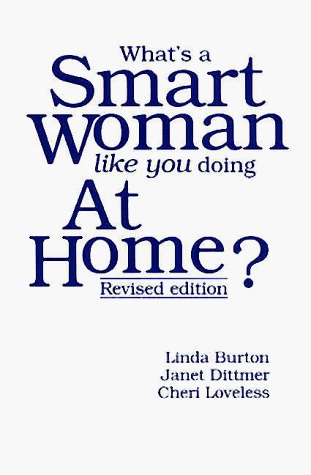 We also faced questions about ourselves. The three mothers who co-founded the organization used one of these questions as the title of their book: What’s a Smart Woman Like YOU Doing at Home?
In the ensuing decades, we’ve paid close attention to the science of human development, to the researchers and clinicians who illuminate the critical importance of human connection and nurturing relationships. The well-being of humans of all ages is impacted by their family, by friends and community members, by media, by educators and policymakers (local, state and national). In 2012, I earned a Bachelor of Individualized Studies degree in Human Development, Parenting and Policy at George Mason University in Fairfax, Virginia. Drawing on my academic studies and information our organization had collected over the years, I wrote an article for our website: Children’s Needs.
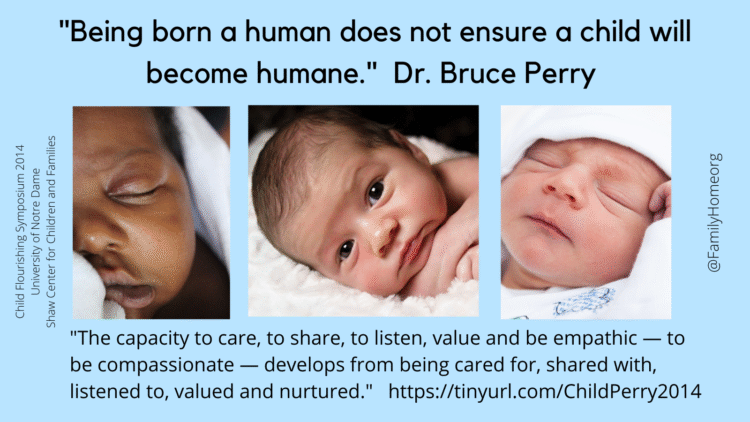
In September 2014 I attended the Child Flourishing Symposium at the University of Notre Dame, organized by Dr. Darcia Narvaez. One of the featured speakers, Bruce D. Perry, M.D., Ph.D, founder of the Child Trauma Academy, emphasized the critical importance of nurturing care and connection and the life-long impact of our experiences in the earliest months of life.
Also in 2014, Dr. Narvaez provided cross-disciplinary, scientific evidence of the components needed for human thriving and well-being in her book Neurobiology and the Development of Human Morality: Evolution, Culture and Wisdom. The book won prestigious awards and Dr. Narvaez was elected a fellow to the American Association for the Advancement of Science.
A few years later, Dr. Narvaez collaborated with Lisa Reagan, renowned activist and publisher, founder of Kindred World. They co-founded The Evolved Nest Initiative, offering educational outreach projects designed to make our “evolutionary pathway to well-being” available to all with short films, monthly discussions, and online learning.”
 “The Evolved Nest is a breakthrough concept that integrates findings across fields that bear on child development, child raising and adult behavior. The Evolved Nest promotes optimal health and wellbeing, cooperation, and receptive and sociomoral intelligences. Societal moves away from providing the Evolved Nest have contributed to the ill being and dysregulation we see in one another and society.” (Evolved Nest website)
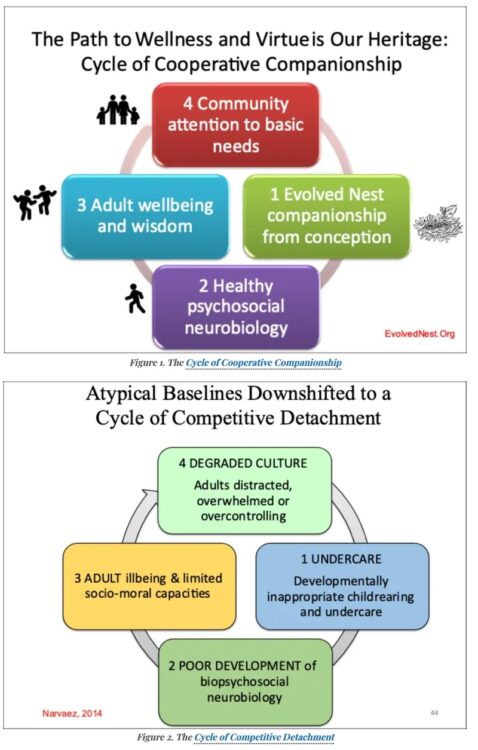
For 99% of human history, the cultural systems that enabled humans to survive featured cooperation between people and with the natural world. In the modern world, cycles of competition and detachment from the natural world are all too common. Many babies do not receive the nurturing and companionship they were born expecting. The following graphic compares a cooperative (or Kinship) cycle to the cycle of competitive detachment.
The foundation of how humans think and organize their societies is their worldview. Unfortunately, the current prevailing worldview is “Competitive Detachment” or “Domination.” This makes it harder for individual families to meet their children’s needs. Recognizing how societal attitudes and practices are out of alignment with what humans need for wellbeing can be discouraging. Yet some individuals, families and communities are determined in pursuing wellbeing. And fortunately, there are visionaries who explore the path to a better way forward, a return to our ancestral wisdom of “Cooperative Companionship” or “Partnership”—the Kinship worldview. For more, sign up for Kindred World’s email newsletter and explore the wealth of information on their website.
This summer, I was immersed in an invitation-only 12-week training, a deep dive into the components of The Evolved Nest and the Kinship mindset that accompanies it. Each week, after reading and watching a wealth of information focused on a component of the Evolved Nest, we met together online. It was fascinating and inspiring to meet other people from around the world, to hear their reflections and learn about their work. I’m grateful to Darcia and Lisa for this opportunity, and I’m now a Certified Nesting Ambassador!