
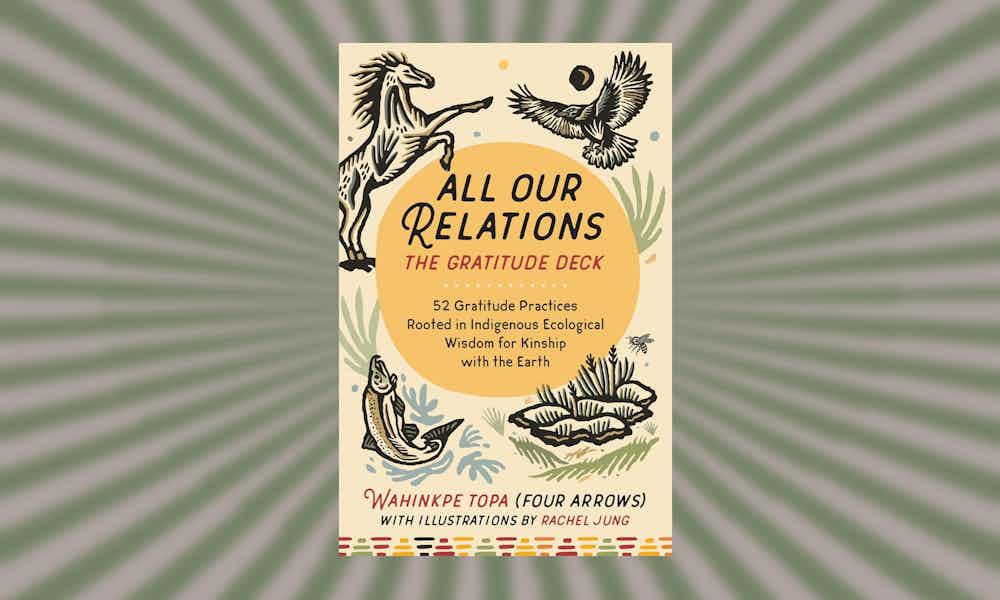
All Our Relations – The Gratitude Deck by Four Arrows
52 Gratitude Practices Rooted in Indigenous Ecological Wisdom for Kinship with the Earth

Release date March 10, 2026
Get Your All Our Relations Gratitude Deck
From Indigenous author, scholar, and activist Four Arrows (Wahinkpe Topa)—cultivate your own earth-based gratitude practice with this 52-card oracle deck.
For readers of Robin Wall Kimmerer, Rae Diamond, Jessica Hernandez, and Sherri Mitchell
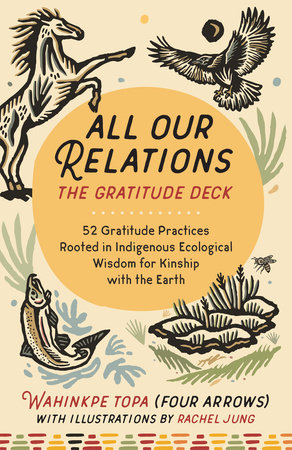
All Our Relations, a 52-card oracle deck, guides readers through a nature-based gratitude practice rooted in the Indigenous worldview. Author Four Arrows (Wahinkpe Topa) invites you to realign your heart and mind with the natural world—to reconnect to your truest self and the more-than-human world, and to move in kinship with the plants and animals that nourish and sustain all of life. This deck offers:
- Myths from 52 Unique Indigenous Nations
- A supporting guidebook to help you deepen your experience and understanding
- 52 woodblock-inspired plant and animal illustrations
This is the first card deck to honor the critical role that sentient non-human beings play in maintaining the ecological balance on Mother Earth through the lens of First Nations cosmologies. Whether you’re a spiritual seeker, nature lover, or mindfulness practitioner, this groundbreaking offering will reroot you in a sacred, healing awareness that has the power to bring new spiritual insights, daily wonders, and interconnected kinship to your life.
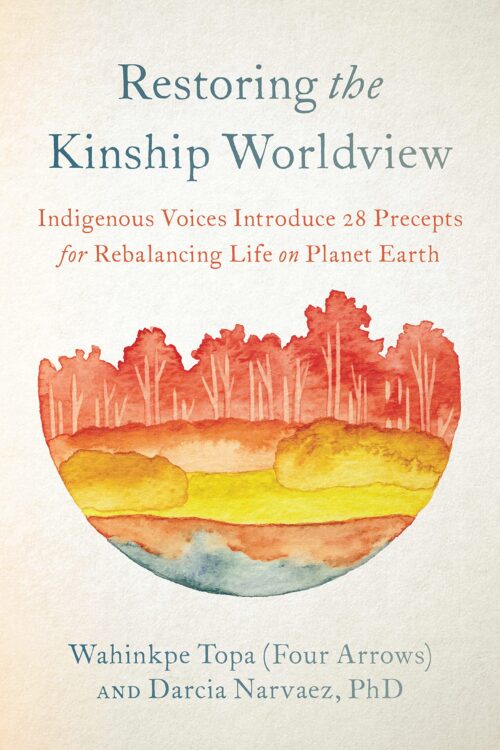
You can read the Introduction to the book, Restoring the Kinship Worldview, by Four Arrows and Darcia Narvaez, here.
WAHINKPE TOPA (FOUR ARROWS), aka Don Trent Jacobs, Ph.D., Ed.D., is internationally respected for his research and publications about Indigenous worldview and education. Formerly Dean of Education at Oglala Lakota College, he is currently a professor with Antioch University. Selected as one of 27 “Visionaries in Education, he has authored many publications, including Restoring the Kinship Worldview. He lives and surfs in Mexico, surrounded by sentient beings.
RACHEL JUNG is a graphic designer/illustrator, dog mom, adventure addict, and the face behind Rayco Design. Her art is inspired by her greatest passions: the outdoor culture, adventure world, and of course, dogs. When she’s not creating, you can find her somewhere in the dirt camping, mountain biking, off-roading, or hiking.
Discovering & Using Kindred’s Worldview Chart By Four Arrows
About the Worldview Chart
 This chart is not intended as a rigid binary, but a true dichotomy best viewed as a continuum. It is meant to encourage seeking complementarity and dialogue. Absolutism is discouraged with the realization we are all participating in DW precepts to some degree. The chart assumes that all diverse cultures, religions, and philosophies can be grouped under one of the two worldviews. “Indigenous Worldview” does not belong to a race or group of people, but Indigenous cultures who still hold on to their traditional place-based knowledge are the wisdom keepers of this original Nature-based worldview. All people are indigenous to Earth and have the right and the responsibility to practice and teach the IW precepts. All have the responsibility to support Indigenous sovereignty, dignity, and use of traditional lands.
For non-Indians who are concerned about misappropriation, see the peer reviewed article,
“The Indigenization Controversy: For Whom By Whom.”
Worldview Chart and introduction by Wahinkpe Topa (Four Arrows), a.k.a. Don Trent Jacobs, Ph.D., Ed.D. Originally published in The Red Road (chanku luta): Linking Diversity and Inclusion Initiatives to Indigenous Worldview, 2020. Featured inRestoring the Kindship Worldview, 2022, by Four Arrows and Darcia Narvaez, Ph.D. Find Four Arrows and more on Indigenous Worldview at www.KindredMedia.org.
The Purpose Of Kinship Worldview
From the book’s epigraph:
According to the United Nations 2019 Global Assessment Report on Biodiversity and Ecosystem Services:
“The findings of this Assessment…are based on an unprecedented collection of evidence, integrating natural and social science perspectives, a range of knowledge systems and multiple dimensions of value. This is the first global-level assessment to systematically consider evidence about the contributions of indigenous and local knowledge and practices to the enhancement and maintenance of wild and domesticated biodiversity and landscapes.” (1)
“The report shows that 75% of the land-based environment and about 66% of the marine environment have been significantly altered by human actions. On average, these trends have been less severe — or avoided — in areas held or managed by Indigenous Peoples.” (2)
“The notion of a good life that most Indigenous Peoples share is deeply relational: the relation to the land with all its interconnected human and nonhuman inhabitants constitutes their collective self-understanding as community. Livelihoods sovereignty is an essential condition to keep this bond. These contributions of nature to notions of a good life may be under threat as access to nature—or key components of nature—are lost.” (3)
“Consumption patterns area fundamental driver of material extraction, production, and flows, but they too are driven—by worldviews and notions of good quality of life.” (4)
“The loss of Indigenous languages is potentially a major problem for value diversity and authenticity. In many regions, community values that support sustainable trajectories using indigenous knowledge are at risk of extinction, which results in the loss of biodiversity. The value of the knowledge-practice-belief complex of Indigenous Peoples relating to conservation of biodiversity are central to the sustainable management of ecosystems and biodiversity.” (5)
Sociocultural framings, norms, worldviews and relational values influence the outcomes of sociotechnological innovations enormously. Nevertheless, these factors remain largely overlooked in studies on sustainable sociotechnological transformations. (6)
From Restoring the Kinship Worldview by Wahinkpe Topa (Four Arrows) and Darcia Narvaez, published by North Atlantic Books, copyright © 2022 by Wahinkpe Topa (Four Arrows) and Darcia Narvaez. Reprinted by permission of North Atlantic Books.
Discussion Questions and Resources
What’s a worldview?
A worldview is a delocalized general sense of how the world works. It’s a cosmology about what humans are, what they should learn, how they should behave and their purpose; how humans relate to the rest of the manifest natural world; and what is our relation to the unmanifest, the spiritual?
Worldview and TEK
Worldview differs from traditional ecological knowledge (TEK) that is localized knowledge Indigenous/First Nation Peoples develops from deep experience in a particular landscape.
So, there are two kinds of Indigenous knowhow missing in the dominant culture that are apparent around the world in First Nation Peoples: the Kinship worldview and TEK. Our book focuses on the former.
How did we lose the Kinship worldview?
Our baselines for normality shifted over time in terms of child raising and cultural practices, downshifting human nature to primate levels. Allowing unfettered inequality has led to endemic Wetiko virus (cannibalistic greed). Modern societies operate trauma-inducing pathways instead of the wellness-promoting pathway we evolved.
How does the Kinship worldview differ from the dominant one?
See the Worldview Chart. Worldview” does not belong to a race or group of people, but Indigenous cultures who still hold on to their traditional place-based knowledge are the wisdom keepers of this original Nature-based worldview. All people are indigenous to Earth and have the right and the responsibility to practice and teach the IW precepts. All have the responsibility to support Indigenous sovereignty, dignity, and use of traditional lands.
“For non-Indians who are concerned about misappropriation, see the peer reviewed article,“The Indigenization Controversy: For Whom By Whom.”
The Worldview Chart and introduction was created by Wahinkpe Topa (Four Arrows), a.k.a. Don Trent Jacobs, Ph.D., Ed.D. and originally published in The Red Road (chanku luta): Linking Diversity and Inclusion Initiatives to Indigenous Worldview, 2020. The chart is featured in Restoring the Kindship Worldview, 2022, by Four Arrows and Darcia Narvaez, Ph.D.
