
 Adobe/Rohane
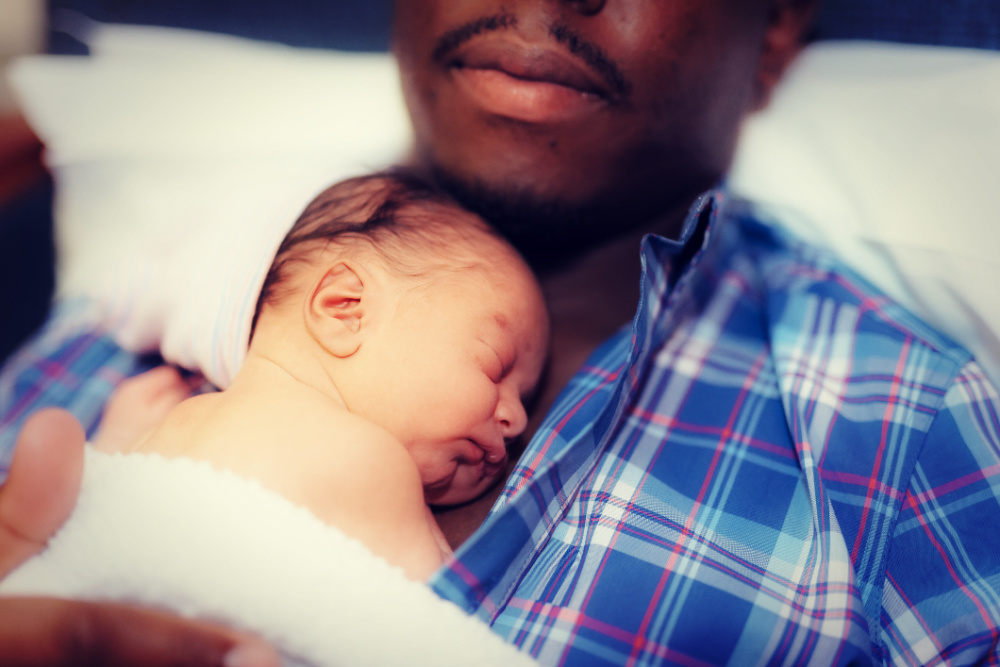
Men Nurture Babies Too
All it takes is a little practice.

There is a lot of focus on the importance of mothers nurturing babies to promote attachment and wellbeing. But our heritage is broader than mother-child alone (e.g., Morelli et al., 2017).
Around 13 million calories are needed to raise a human child until their late teens when they can produce as much as they consume. Mothers cannot by themselves provide the nutrition needed. Thus, humans evolved allomothering/alloparenting, a community of carers (Burkart et al., 2009; Hrdy, 2009).
Among hunter-gatherers, who are matrilineal and don’t pass on property to the next generation, the children are raised by the community. When a 17th century Jesuit priest, coming from patriarchal civilization, told Montagnais-Naskapi foragers that a woman loving anyone other than the husband was committing evil because it would be impossible to know who the father was, the priest was told: “Thou hast no sense. You French people love only your own children; but we all love all the children of our tribe” (reported in Leacock, 1980, 31).
Isn’t there a difference between mother and father nurturing interests?
True, there is something about testosterone. Men’s testosterone levels reduce when holding a responsive baby but skyrocket with an inconsolable baby (in research done with preprogrammed dolls) (van Anders et al., 2012). Yet with high testosterone, the orbitofrontal cortex is deactivated, which is associated with impulse control and with Kinchenschema (‘baby lust’), being entranced by a baby (Mehta & Beer, 2010).
However, hearing infant distress cries seems to activate a “universal brain-based caregiving instinct” among parents and non-parents, females and males (Young et al., 2016). Men are biologically prepared to be nurturing, given the appropriate circumstances. Men can be as entranced with babies as women, given the same amount of exposure.
Two researchers of fathers and their children point out:
“With the exception of lactation, there is no evidence that women are biologically predisposed to be better parents than men are. Social conventions, not biological imperatives, underlie the traditional division of parental responsibilities” (Michael Lamb, 1984, p. 423).
“Aka fathers [residents of the African Congo basin] spent nearly 50 percent of each 24-hour period within arms’ reach of their infants, hugging, nuzzling or kissing them some 9 percent of that time, actually holding one-to-four-month-old babies as much as 22 percent of the time, the highest rate of paternal involvement ever recorded…Aka fathers spent hours lounging around camp in relaxed, intimate proximity to babies and older children, just “being there” (Hrdy, 2024, p. 19, reporting on the findings of Barry Hewlett, 1992).
What fosters nurturing in men?
 The key to a nurturing attitude by human fathers is intimate exposure to infants. The United States Department of Health and Human Services noted that 9/10 American fathers who live with at least one child under age 5 report helping bathe, diaper, dress, toilet with the child at least several times a week. All reported playing with them (Jones & Mosher, 2013). This prolonged intimate caregiving changes the brain of the father, overriding conscious commitment and replacing it with more reflexive nurturing, closer to instinct (Hrdy, 2024).
Even before birth, expectant dads with positive expectation have increased prolactin, which is associated with quicker response to infant cries. Testosterone levels fall with infant care over time (which is associated with increased empathy) in both fathers and mothers.
How about Infant Attachment?
Courtney Meehan & Sean Hawks reported that Aka infants can learn to trust and attach to around 5 familiar, responsive carers. The emphasis on maternal attachment in Euro-American societies is not born out by research around the world where there are multiple responsive nurturers on hand, much like our species-normal heritage.
See the Global Fatherhood Charter which seeks more family-friendly policies and urges fathers to become more involved in nurturing the young.
References
Burkart, J.M., Hrdy, S.B., & Van Schaik, C.P. (2009). Cooperative breeding and human cognitive evolution. Evolutionary Anthropology, 18, 175-186. https://doi.org/10.1002/evan.20222
Gettler, L. T. (2014). Applying socioendocrinology to evolutionary models: Fatherhood and physiology. Evolutionary Anthropology, 23(4), 146-160. doi: 10.1002/evan.21412
Hewlett, B. (1992). Intimate fathers: The nature and context of Aka Pygmy paternal infant care. University of Michigan Press.
Hrdy, S. B. (2009). Mothers and others: The evolutionary origins of mutual understanding. Cambridge, MA: Belknap Press.
Hrdy, S. B. (2024). Father time: A natural history of men and babies. Princeton University Press.
Jones, J., & Mosher, W.D. (2013). Fathers’ involvement with their children: United States 2006-2010. National Health Statistic Reports n. 72, December 20.
Kuo, P.X., Braungart-Rieker, J.M., Burke Lefever, J.E., Sarma, M.S., O’Neill, M., & Gettler, L.T. (2018). Fathers’ cortisol and testosterone in the days around infants’ births predict later paternal involvement. Hormones and Behavior, 106, 28-34. doi: 10.1016/j.yhbeh.2018.08.011.
Lamb, M. (1984). Observational studies of father-child relationships in humans. In D.M. Taub (Ed.), Primate paternalism (pp. 407-430). Van Nostrand Reinhold.
Leacock, E. (1980). Montagnais women and the program for Jesuit colonization. In M. Etienne & E. Leacock (Eds.), Women and Colonization: Anthropological Perspectives (pp. 43-62). Praeger.
Meehan, C.L., & Hawks, S. (2014). Maternal and allo maternal responsiveness: The significance of cooperative caregiving in attachment theory. In H. Otto & H. Keller (Eds.), Different faces of attachment: Cultural variations in a universal human need (pp. 113-140). Cambridge University Press.
Mehta, P., & Beer, J. (2010). Neural mechanisms of the testosterone-aggression relations: The role of the orbitofrontal cortex. Journal of Cognitive Neuroscience, 22, 2357-2368.
Morelli, G.A., Chaudhary, N., Gottlieb, A., Keller, H., Murray, M., Quinn, N., Rosabal-Coto, M., Scheidecker, G., Takada, A., & Vicedo, M. (2017). Taking culture seriously: A pluralistic approach to attachment. In H. Keller & K.A. Bard (Eds.), The cultural nature of attachment: Contextualizing relationships and development (pp. 139-170). MIT Press.
Van Anders, S.M., Tolman, R.M., & Volling, B.L. (2012). Baby cries and nurturance affect testosterone in men. Hormones and Behavior, 61, 31-36.
Young, K.S, Parson, C.E., Emholdt, E.-M.J., Woolrich, M.W., van Hartevelt, T.J., Stevner, A.B.A., Stein, A., & Kringelback, M.L. (2016). Evidence for a caregiving instinct: Rapid differentiation of infant from adult vocalizations using magnetoencephalogy, Cerebral Cortex, 26, 1309-1321.