

How do we welcome babies to enhance their wellbeing?
- Mbuti mothers of the Congo invent a unique song for their womb-child, singing about the maternal generosity of the forest.
- Sperm Whale mothers too invent a [clicking] song for their child and when they sing it, the rest of the pod stays silent so the baby can learn it.
- The Elephant clan of females and related offspring surround the newborn elephant with welcoming touches.
- Emperor Penguin dads welcome the single egg after it is laid and keep it warm with a group of dads for the two months until eggs hatch and mothers return from feeding to share care.
- Dagara children gather together and shout ‘welcome’ when the baby emerges from the womb.
In capitalist societies, we are immersed in far-heartedness from babyhood on. Instead of being present to babies and children, near-hearted, we are following scripts for how to shape them into acceptable members of society—whether medicalized birth, hospital-type practices at home (scheduled feedings and sleeping and separation), drills and worksheets at school. Instead of accompanying children as they unfold their gifts in a supportive, nested community, we don’t listen to their inner compass. Instead, we use force to make them far-hearted too.
Human infants expect a welcoming right-brain-to-right-brain interbeing from the get-go (Trevarthen, 2005). This helps them grow cellular mitochondria, the energy batteries of the body, and much more (Schore, 2025). Although westerners emphasize mothers as the interbeing companion, humanity’s heritage is to have a community of multi-aged others who share interbeing with a baby.
Welcoming baby entails providing for the child’s basic needs. This means not starving the child’s need for affectionate touch, for acceptance, for integration into community activities, for play with multi-aged others—for the evolved nest. We act and cultivate near-heartedness.
If you have a baby but don’t feel deeply connected, carry the infant skin-to-skin. If it is an older child, figure out ways to have lots of touches—through cuddles or wrestling or playful games (e.g., how many can fit into the closet?) or tackle your teen with a hug (Narvaez & Barrett, in press).
References
Narvaez, D., & Barrett, E. (in press). A Researcher and a Psychotherapist Discuss Humanity’s Evolved Nest. Australian and New Zealand Journal of Family Therapy.
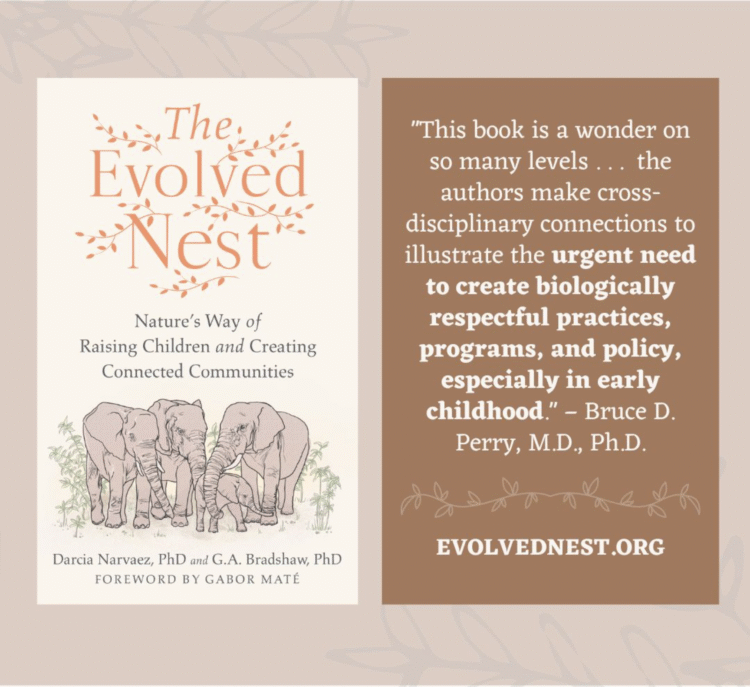
Narvaez, D., & Bradshaw, G.A. (2023). The Evolved Nest: Nature’s Way Of Raising Children And Creating Connected Communities. North Atlantic Books.
Schore, A.N. (2025). The right brain and the origin of human nature. W.W. Norton.
Trevarthen, C. (2005). Action and emotion in development of the human self, its sociability and cultural intelligence: Why infants have feelings like ours. In J. Nadel and D. Muir (Eds.) Emotional Development (pp. 61-91). Oxford: Oxford University Press.
Trevarthen, C. (2005). Stepping away from the mirror: Pride and shame in adventures of companionship—Reflections on the nature and emotional needs of infant intersubjectivity. In C.S. Carter, L. Ahnert, K.E. Grossmann, S.B., Hrdy, M.E. Lamb, S.W. Porges, & N. Sachser (Eds.), Attachment and bonding: A new synthesis (pp. 55-84). Cambridge, MA: MIT Press.