
Breaking Up with the Patriarchy, An Interview with Author, Susan Herrmann
Includes the foreword to the book by Four Arrows

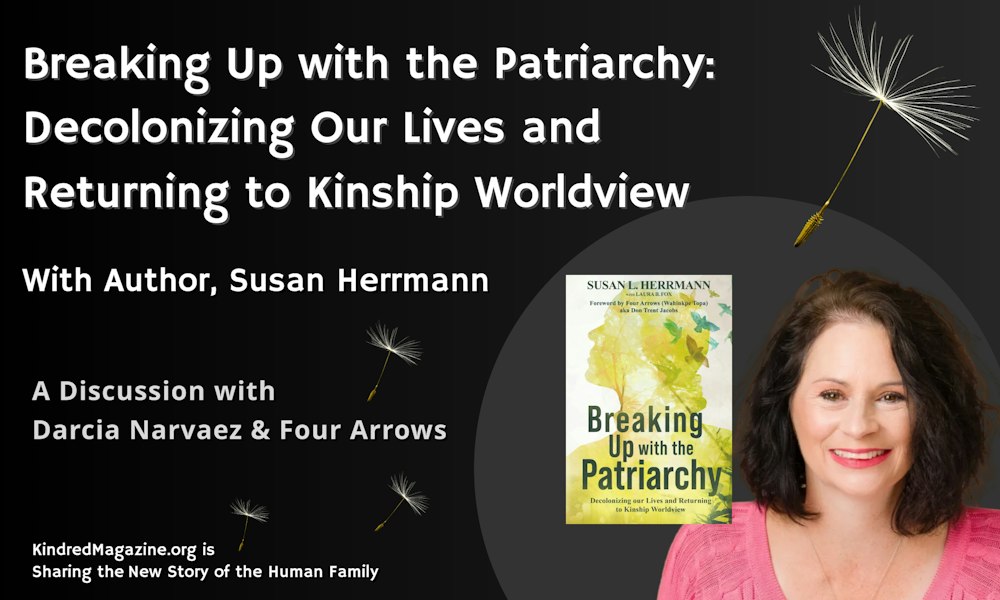
About the Interview
What are the implications for Western psychology when worldview is integrated as a framework for healing?

Welcome to a discussion with Susan Herrmann, the author of Breaking Up with the Patriarchy: Decolonizing Our Lives and Returning to the Kinship Worldview. This discussion includes hearing Susan’s story of first encountering the power of worldview in her work with Agent Orange survivors in Vietnam, and over time, developing these insights into a practical therapy model. Her work was inspired and supported by Indigenous Worldview scholar, Four Arrows, and his Worldview Chart (see below and www.WorldviewLiteracy.org), and Darcia Narvaez, award-winning researcher of the transdisciplinary Evolved Nest holistic science theory. Susan’s book, Breaking Up With the Patriarchy, was inspired by her patients and their breakthroughs in healing with worldview shifting.
Four Arrows and Darcia Narvaez, co-authors of Restoring the Kinship Worldview, join the discussion and reflect on the growing urgency and demand for worldview literacy, the challenges of meeting these needs, and ultimately, as Susan shares, the potential for decolonizing Western psychology and supporting the human family to claim its rightful inheritance to Kinship Worldview.
Below you will find:
- The video interview with Susan Herrmann, and then Four Arrows and Darcia Narvaez join the discussion.
- The foreword to the book by Four Arrows.
- A description of the book.
- More resources for continuing your worldview journey.
Enjoy the Discussion: Breaking Up with the Patriarchy
Breaking Up with the Patriarchy: Decolonizing Our Lives and Returning to Kinship Worldview
Foreword
by Wahinkpe Topa (Four Arrows)
I have often said that I learn more from my doctoral students than they learn from me. Susan exemplified such learning when she was my student, but I continued to learn from her for years afterward as “Dr. Herrmann.” Even when we were talking about my own area of scholarship relating to worldview literacy, self-hypnosis, decolonization, and Indigeneity, she gave me insightful and practical ways to use my own worldview chart!
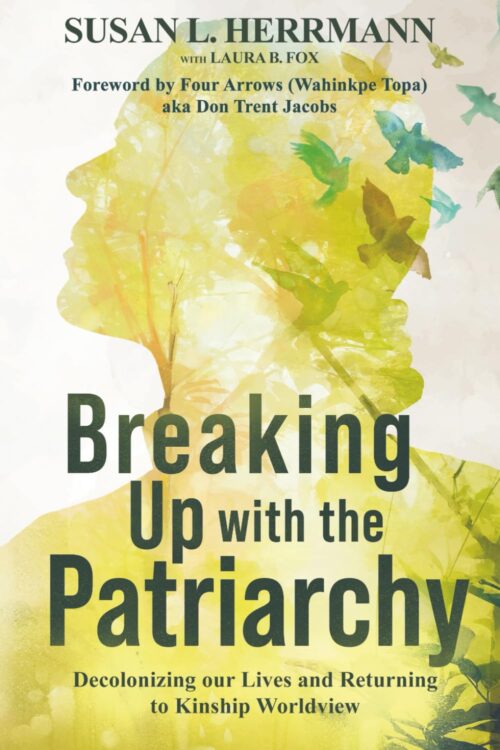
This book reveals such understandings via stories, strategies, and ideas, emphasizing connections between healing and the stifling of patriarchy and other disconnecting colonial worldview precepts. Susan’s fearless, passionate, and well-considered pages tell her story in ways that will help anyone reclaim our original Nature-based worldview so as to significantly bring forth healing. As she writes, she intends this book to be “an invitation to discover who you really are when you stop performing the roles the patriarchy assigned you.”
Susan is forthright with her own stories of suffering and healing, but only in ways that inspire. Her passion for our ancestors, the land, the waters, the four-legged and winged ones, the seen and the unseen is legitimate. She is not “playing Indian” or disrespecting the importance of Indigenous voices. She speaks from her heart because she has personally learned that we are not separate from other-than-human teachers. She knows they live in us all as surely as our own hearts beat and we breathe the oxygen of ocean plants and rooted ones in a partnership of life. Thus, her stories and teachings are ultimately not merely “new” but part of an ancient conversation.
This book is part of that conversation. It asks us to remember that human beings are not meant to live cut off from one another, from the Earth, or from the deep knowing carried in our bones. In my own Lakota way of seeing, every being carries wówačhaŋtognaka—generosity of spirit—and wóksape—wisdom—given to them at birth. The problem is not that we have lost these gifts, but that layers of fear, domination, and false stories have covered them over.
Susan’s journey, shared with such honesty, is an act of pulling back those layers. Her stories are not meant to draw sympathy but to serve as mirrors. As you read, you may see your own wounds reflected—personal wounds and the larger wounds we carry as a people living in a world shaped by patriarchy and separation. In Indigenous ways, we know that naming the wound is the first step to healing it. But naming is not enough—we must also return to wóohitike—courage—and to mitákuye oyás’iŋ—the lived truth that “we are all related.”
Forgetting our place in the circle of life is not the natural state of humanity. Rather, it is the result of historical forces that have severed kinship ties, first with the Earth and then with one another. In Indigenous memory, there is no “I” without “we.” Susan calls this remembering, and we might also call it coming back into right relation. This is not a nostalgic return to an imagined past, but a present choice to live in a way that honors the old agreements between people and Creation.
Colonial and patriarchal systems thrive by convincing us that the harm we’ve experienced is our own private burden, a shame to be hidden. Yet Indigenous ways tell us that wounds are carried in the bundle of the people, and so too is the healing. Susan’s call to “release legacy burdens” parallels the healing ceremonies in which one person’s courage to speak truth becomes medicine for the whole community. The Kinship Worldview she explores is not a philosophy—it is a lived reality. Wholeness is not a private goal for one’s own life habits so much as it is the recognition that self, community, and Earth are interwoven. Reconnecting removes what does not belong until what is left is who we have always been.
Once we begin to heal these wounds, we face the task of moving beyond the fear that keeps us trapped. Fear can be a temporary gift, warning us of danger. But when it becomes our constant lens, it blinds us to possibility. Indigenous traditional worldview sees courage as a virtue for making a commitment and fearlessness as the trust in the Universe when the commitment is acted upon. This fearlessness opens the door to genuine connection. In our original ways, belonging was a given from the moment of birth. Susan invites us back into authentic community, which in Lakota we call tióšpaya, the extended family. This includes not only human kin but all of Nature.
Our separation from Nature is killing us—physically, emotionally, and spiritually. Colonization worked to convince people the Earth was an object to control rather than a relative to honor. Susan guides us back to this essential relationship, showing how reconnection heals what isolation has broken. Yet reconnection requires releasing our illusion of control. Indigenous teachings remind us that life is movement, like a river. We cannot stop it, but we can choose the best route as we float downstream.

This surrender to life’s flow opens us to deeper ways of knowing. Wisdom resides more in the heart and spirit than in the mind. Susan knows how to listen with the whole self in ways that reflect čhaŋté (heart), nagí (spirit), and wičhóȟ’aŋ (actions) working together in harmony so that we are aligned with truth. This wholeness naturally restores balance between feminine and masculine energies—a balance that was as natural as night and day before patriarchy distorted it. Susan shows how to restore this balance not as a battle, but as the weaving of complementary strands. In Indigenous worldview, the feminine energy was sacred.
All of this healing happens within cycles of time that mirror Nature’s own rhythms. For many Indigenous peoples, time is not a straight road but a circle. The seasonal cycles that guide planting, harvesting, and renewal also guide our healing, which unfolds over many such cycles. Indigenous languages once carried the place-based knowledge of how to live well within these cycles. While many of these languages have been silenced, we can still learn how to use courage and love on behalf of freedom. Susan’s “thirteenth ripple” and “seeds in the ruins” remind us that even in the rubble of the old world, new life is already taking root.
This book is a medicine bundle, but medicine works only when it is taken in. Read these pages with the willingness to be changed. Try the practices. Share them. In Lakota thought, the circle grows stronger every time someone brings their gifts back to it.
The systems of separation are collapsing under their own weight. What replaces them will depend on the stories we choose to live now. Susan offers here not just a critique of the old ways, but a living pathway forward that resonates deeply with Indigenous understandings yet belongs to all who choose to walk it.
When you finish this book, do not place it back on the shelf as if the work is done. Carry it into your daily life, into your relationships, into your choices. Let it change how you greet a neighbor, how you speak to a child, how you tend a tree. In this way, the break from patriarchy becomes not just an idea but a lived reality—one choice, one conversation, one act of courage at a time.
Mitákuye oyás’iŋ—We are all related. And because of that, your healing is my healing, my healing is yours, and the Earth’s healing belongs to us all.
—Wahinkpe Topa (Four Arrows), 2025
About the Book
There’s a way of being human that predates the story we were handed. It sustained our species for 99% of our existence. It is still ours to remember.
The anxiety about our children’s future. The grief for a planet in crisis. The loneliness of a culture that calls itself “connected.” These are the felt experience of living inside patriarchy, a worldview that has severed human beings from their own wisdom and from kinship with all life for the past 10,000 years.
In Breaking Up with the Patriarchy, therapist Susan L. Herrmann names what you already sense. The suffering is real, and it is systemic. The relational framework Four Arrows (Wahinkpe Topa) calls the Kinship Worldview, and introduces in his foreword, offers a practical path home.
Drawing on three decades of clinical practice, personal storytelling, and the relational wisdom at the heart of Indigenous thought, Herrmann guides readers through a calm reckoning with inherited patterns of domination and separation. You’ll learn to:
- Recognize the patriarchal conditioning you’ve absorbed without consent
- Understand mental and emotional struggle as a natural response to an unnatural system
- Rebuild trust in your body, your intuition, and your capacity for authentic community
- Relate to the Earth as living kin
- Practice Radical Surrender, acting from integrity while releasing attachment to outcome
This is an invitation to trust your inner wisdom, connect with others as sovereign beings, and meet what life brings with intelligence and heart.
One reader writes that this book “dismantles the lens you were using to see the world and offers something to replace it with, which is rarer than it sounds.”
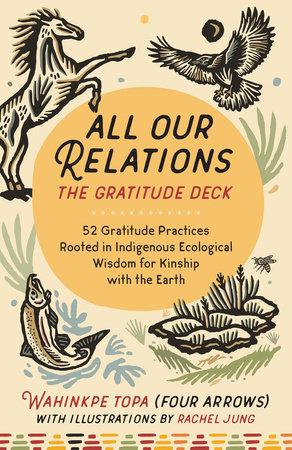
RESOURCES
- Read an excerpt from Breaking Up With the Patriarchy here: Chapter Three, The Return to Wholeness
- Discover the Worldview Chart by Four Arrows in multiple languages, along with a 90-day self-study program at www.WorldviewLiteracy.org
- Read the introduction to Restoring the Kinship Worldview by Four Arrows and Darcia Narvaez.
- Listen to presentations by Nesting Ambassadors who are integrating Nested Kinship into therapeutic practices and professional fields:
- Integrating Evolved Nest Science into Nature and Art Therapy
- Integrating Evolved Nest Science into Systemic Family Therapy
- Download Susan’s group discussion and study guide to Breaking Up with the Patriarchy.