
Tending the Living Soil of the Nest: A Kinship Praxis Wisdom Weaving
A Nesting Ambassador Kinship Praxis Presentation

 Adobe/Margarita
Below is the Kinship Praxis presentation from the Nesting Ambassador Program in October. In addition to being able to sit in on the Wisdom Weaving Teaching, you can read the transcript and find references and resources below the recordings. We are currently accepting applications for the Nesting Ambassador Program’s Spring 2027 Cohort here.
WATCH THE PRESENTATION
Wisdom Weaving: Tending the Living Soil of the Nest
EDITED TRANSCRIPT
Personal Origin Story
After 9-11, I moved out of a gated community and onto a farm. On the day-of 9-11, I was sitting in the master bedroom watching the second tower fall, looking out at the 14th hole of a golf course. My husband and I had been married ten years before we had a child. We had checked every box we thought defined success, especially for me as a class migrant.
As that second building came down, I felt my ancestors with me. I turned my head, looked out the window, and knew: I can’t grow food on that. What am I doing here? I have to leave.
I began attending conferences on sustainable agriculture. We moved across the county to a small farm and I started a CSA.
What Regenerative Agriculture Actually Requires
What I learned immediately was striking. In truly sustainable growing, only about 10% of what we cultivate is food for harvest. Roughly 60% is cover crops; the remaining 30% supports the system. This is according to the Grow Biointensive method I was trained in and used, along with Biodynamics, for the Community Supported Agriculture, CSA, I created on our small Virginia farm.
Grow Biointensive was pioneered by John Jeavons at Ecology Action in Willits, California. His book How to Grow More Vegetables shows how to grow the maximum amount of food in the smallest space with the least resources. The method is now used in more than 110 countries.
To be regenerative, most of the effort must go into cover crops, building tilth, growing soil, and growing earth. High-calorie tubers then provide the most efficient human nutrition by weight and area. Only about 10% of the land is expected to produce the vegetables we typically buy in a store.
This understanding – only 10% of land will be used for food production – forced me to recalculate everything—how I would make a living and what “success” even meant.
Growing Conditions Rather Than Extracting Abundance
 Regenerative agriculture is sustainable because the majority of the land and attention goes toward generating the biomass and structure that make fertility possible. If you chase only the 10% food crops without the compost base, the soil depletes. Sustainability depends on keeping that proportion.
The method works by growing the conditions for abundance rather than extracting abundance directly.
Dominant-worldview agriculture does the opposite: it is extractive and depletive, and therefore unsustainable. Monocropping, industrial techniques, and chemical forcing push food to grow while neglecting the soil itself. That approach is visible on the Worldview Chart in its precepts and mindsets.
Applying the Metaphor to the Nest
What if we use this same understanding to tend the nest sustainably—treating the relational and cultural field as living soil?
From my years in the breastfeeding world, I watched hospitals create long checklists: baby on the breast—check; other boxes—check, check, check—then out the door. That is what their system requires. It does not ensure longevity of breastfeeding, change culture, or normalize nurturing. It is a dominant-worldview approach: extract a piece, declare a goal achieved, and move on, rather than tending the living soil of the culture that actually needs transformation.
The Evolved Nest and the Surrounding Field
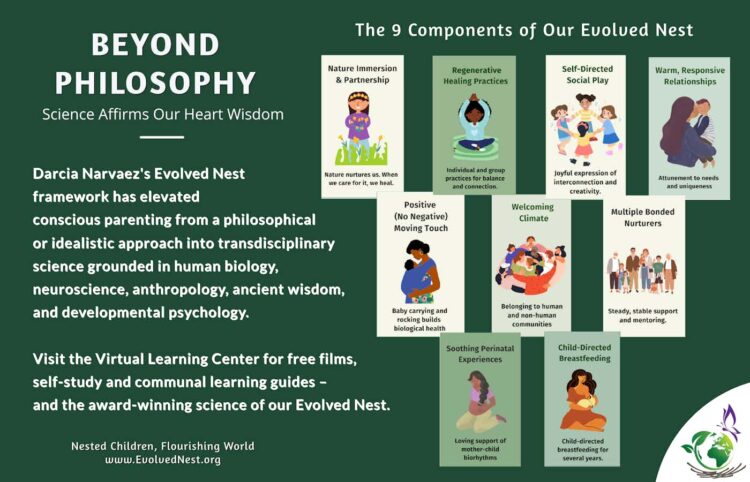
The Evolved Nest (now ten components) describes specific, measurable practices that support optimal human development. Those practices may not be possible, however, if the surrounding relational-ecological field is thin, coercive, or extractive.
Most of the ongoing work of tending the nest is therefore the equivalent of cover crops and compost: the repeated ordinary acts that build the tilth of safety, co-regulation, belonging, and kinship capacity.
Releasing Performance Pressure
When we look at the components and feel pressure to change the world, check boxes, or “do the thing,” we are usually encountering the Dominant Worldview’s emphasis on performance, achievement, and goal orientation.
This is why we spend time on worldview and on working with our bodies in the Nesting Ambassador Program through the Learning Experience of the Evolved Nest. When we shift, become mindful of where we are, and tend our own bodies and nests, something else becomes possible. We can see the living field and build the tilth of safety, co-regulation, belonging, and kinship capacity in ongoing, more human and sustainable ways.
What the Learning Experience Prioritizes
This is why the Learning Experience of the Evolved Nest sequences the way it does. The practices that grow the soil include:
- Presence and co-regulation before content
- Nature immersion and multi-entity listening (bringing relational intelligences online)
- Restorative and ceremonial practices that metabolize stress and repair rupture
- Play and voluntary movement that keep the system flexible
- Worldview literacy that loosens domination narratives so other possibilities can be perceived
The sequence begins with nature connection, restorative healing practices, and play.
Growing Soil, Not Harvesting Components
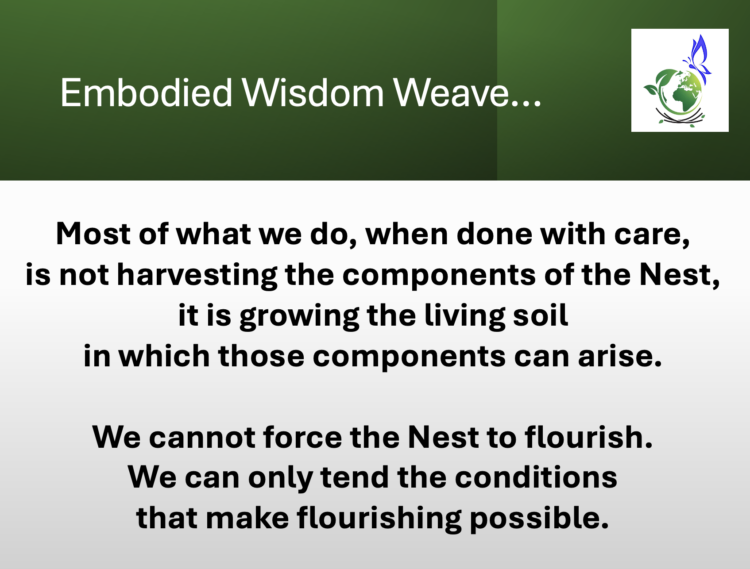
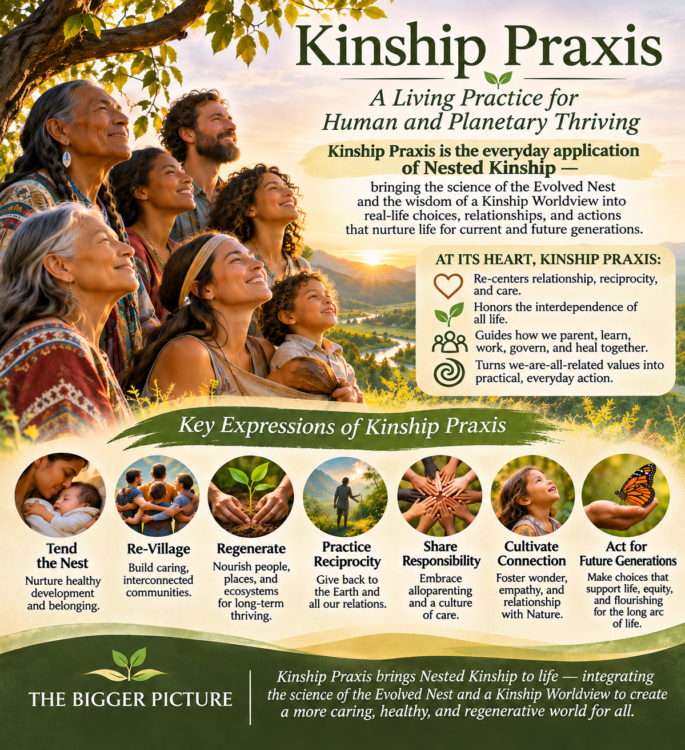 Most of what we do, when done with care, is not harvesting the components of the nest. It is growing the living soil in which those components can arise. We cannot force the nest to flourish. We can only tend the conditions that make flourishing possible.
Tools for Distinguishing Tilth from Yield
The Worldview Chart helps when we feel confused about where thoughts and narratives are coming from. Four Arrows’ All Our Relations gratitude card deck contains the chart folded inside—a practical tool for Nesting Ambassadors to revisit metacognitive awareness. When we notice or feel “it is not one thing but everything”, we know we’re encountering a worldview issue.
In our Kinship Praxis and Embodied Wisdom Weaving, we learn to distinguish between:
- Building nest tilth (the majority, ongoing work), and
- Harvesting specific components (the smaller, dependable yield).
Checking the box—“baby on the breast,” “parents stopped cry-it-out”—can be useful, but it does not tend the entire field. The field is tended through daily practices, embodiment, and readiness to share the science and know-how of the Evolved Nest.
As Nesting Ambassadors we can notice where our current attention sits on that spectrum. Practices like the 5-4-3-2-1 mindfulness we did today train us to shift attention and integrate our senses. Especially when assessing nestedness and unnestedness (as in the Coming Through game), we can identify one or two concrete ways to increase the proportion of “compost crop” activity in a personal, family, or community setting without abandoning the components.
Conditions That Make Thriving Visible: Ghost Pipes
Last year in the woods near my home, I found hundreds of ghost pipes—native wildflowers without chlorophyll that look like pipes (sometimes called corpse flowers). Normally one sees a clump; hundreds together is extraordinary. The conditions had to be perfect to support this phenomenon.
I researched ghost pipes (online) and invited the land and nature, a lifelong practice of Ecofluency/relational intelligence (Kinship Worldview), into the process of understanding what I was witnessing. The message that came through was clear: it is absolutely possible to create conditions in our living human social field that support thriving at a level most people cannot imagine or expect.
Cultural Shift Already Underway
Kiss the Ground (featuring Woody Harrelson and others) reports that consumer understanding of regenerative agriculture has tripled in the past three years. Advocates have been encouraging even small shifts on working land. Shame, startup cost, the need for a plan, and the worldview commitment required have slowed adoption, but interest is real. People now want to know what “regenerative” means.
This growing awareness and interest does not apply only to soil. It applies to how we tend our animated Earth bodies and our social living field. If interest in regenerative agriculture can triple, it is reasonable to expect Evolved Nest science to be welcomed across multiple fields and for humanity to flourish. Why not?
Looking Ahead: Otto Scharmer and Theory U
Next time we will look at MIT professor and system analyst’s Otto Scharmer’s Theory U. Scharmer grew up on a 300-year-old German farm shaped by Rudolf Steiner’s Biodynamic view that the Earth is living. His family interacted with the land as a living system they could listen to.
When Scharmer developed Theory U for cultural transformation, he brought that worldview—life is conscious—into systems work. What his work shows is that there are no systems; there are coalitions of stakeholders. (I wrote about this on Kindred through the Wizard of Oz lens: systems appear to be flaming all powerful heads, but they are usually just a human, or a coalition of human stakeholders, hidden behind a crafted curtain.)
These emergent frameworks, like Theory U, give us reason to hope and confirm that what we are attempting is possible. Anything that says otherwise is usually a dominant worldview story. And we know what to do with that: breathe.