

Most children are required to attend school, but if you haven’t noticed, it historically moves against species-normal evolved nest principles. There is:
- Minimal welcoming of students’ unique interests.
- A lack of self-directed freedom to learn and play through whole-body experiential learning.
- Absence of welcomed affection, multi-age peer groups, and a village of trusted mentors.
Thus, schooling is not oriented to fostering species-normal wellbeing. Too often it focuses on preparing students for doing boring tasks and obeying bosses instead of a flourishing life.
The dominant industrialized-capitalistic-technocratic system undercares for babies and children for a variety of reasons. These include an overall focus on production instead of on wellbeing (even during childbirth) and its interest in fostering obedience to system demands (as schooling and workplaces insist). Not much freedom or autonomy allowed, which are species’ needs.
In contrast, wellness-promoting cultures honor humanity’s millions-year-old heritage of nurturing wellbeing. Freedom and respect for personal agency are ground rules. The community welcomes each person’s true self, lovingly nurtured into being.
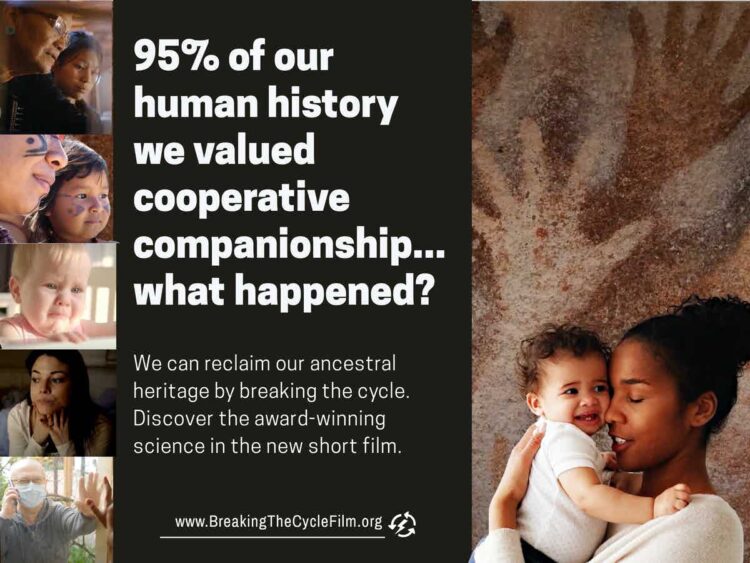
Our wellness-promoting heritage is the cycle of connected cooperative companionship:
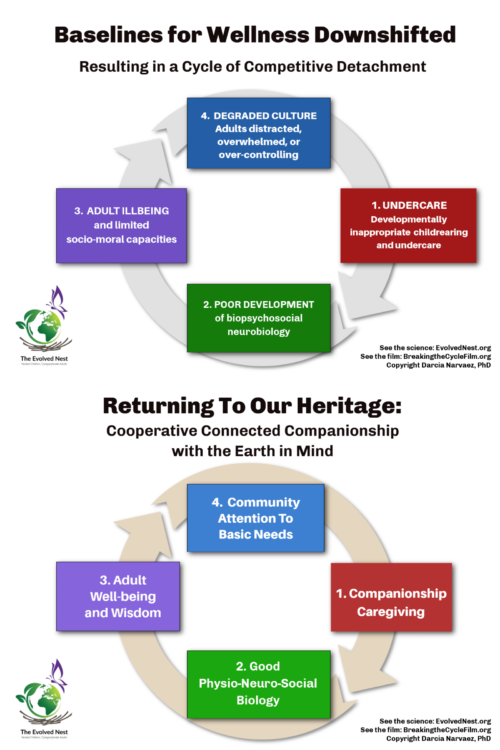 Basic needs are met through the Evolved Nest in early life (and throughout life)à fostering healthy individuals biologically, psychologically, and socially. àThese nested folks grow into healthy, wise adults and àthey keep the cycle going. They are able to truly connect to others, true self to true self (right brain to right brain; Schore, 2025).
Wellness-promoting cultures are more likely to cultivate teachers with democratic characters, who are more creative, nurturing, and responsive to students. In wellness-promoting cultures, students are more likely to enter the classroom with social skills, ready to learn.
But the majority of us live in trauma-inducing cultures where most babies and children receive little of the evolved nest and so carry forward a false self. The dominant culture actually requires the development of a false self—i.e., ego self-protections to make it through each day. Our desires for mutual recognition and loving presence are ignored and suppressed (Gabel, 2018). Trauma-inducing cultures force people into playing roles that keep the system going, a system that is reified as ‘the way things are.’
In a predatory capitalist system, the lives of a few are promoted with promises that anyone can win the rat race to the top if you work hard enough. That is mostly an illusion. Instead, various coercions are used to keep the existing hierarchy in place. Coercions (e.g., perpetual debt, low wages, high prices) maintain the inequalities of the system, guided by seemingly random biases (Stuart, 2025). Obedience and staying in your place are expected, or punishment ensues.
Schools prepare children to fit into this system.
Thus, most societies today are caught in the cycle of competitive destructive detachment, a trauma-inducing pathway. In this cycle, basic needs are not fully met at any age, à which has especially detrimental effects in the first six years of life when the individual self-organizes brain and body functioning-for-life around experience. àAs a result across generations, humanity is increasingly unwell biologically, psychologically and socially, à fostering adults who keep this cycle going because they think it is normal or necessary. àIndividuals and communities are increasingly dysregulated, as it worsens across generations, and get stuck in self-protectionist modes, unable to escape. Feelings of scarcity and insecurity are conditioned into the deepest parts of the brain.
In a trauma-including culture, teachers are encouraged to control students—how they behave and what they focus on. Many students arrive wounded from early unnestedness. They tend to be distrustful, easily triggered into withdrawal or aggression, and have listening and learning difficulties. Dr. Bruce Perry and M. Szalavitz (2006) point out what early trauma can look like in the classroom:
“In a classroom setting, unfortunately, both dissociation and hyper-arousal responses look remarkably like attention deficit disorder, hyperactivity or oppositional defiant disorder. Dissociated children quite obviously are not paying attention: they seem to be daydreaming or “spacing out,” rather than focusing on schoolwork, and indeed, they have tuned out the world around them. Hyper-aroused youth can look hyperactive or inattentive because what they are attending to is the teacher’s tone of voice or the other children’s body language, not the content of their lessons.
The aggression and impulsivity that the fight or flight response provokes can also appear as defiance or opposition, when in fact it is the remnants of a response to some prior traumatic situation that the child has somehow been prompted to recall. The “freezing” response that the body makes when stressed—sudden immobility, like a deer caught in the headlights—is also often misinterpreted as defiant refusal by teachers because, when it occurs, the child literally cannot respond to commands.” (p. 51)
How can educators respond to their wounded students? Certainly, it is important to be trauma-informed in one’s practice—avoiding triggering. But that is not enough.
How can teachers bring evolved nestedness to the classroom?
 Here are some suggestions for educators, starting with trauma-informed practice, followed by wellness-informed practice.
1- BE TRAUMA-INFORMED. Understand adverse childhood experiences (ACEs).
Children may arrive with unhealed trauma from gestational or birth experiences, family life abuse and/or other experiences, making it hard for them to settle and learn. Children may arrive with impaired self-control, acting out when stressed (e.g., test taking). They may be distrustful of adult authority and it may take time to develop a trusting relationship (Watson & Eckert, 2003).
2- Provide a calm, nurturing space.
Offer a beautiful, calming setting (low lights, comfortable optional seating, beautiful art on the walls, plants, a classroom pet).
Resource: https://blog.calmclassroom.com/classroom-set-up-ideas-how-do-you-create-a-peaceful-classroom-environment
3- Help students learn self-calming and self-regulation.
Practice healthful relaxation techniques, self-calming and positive co-regulation (e.g., visualization, calming songs or music). Practice group relaxation (e.g., using humming, music).
Resource: https://self-reg.ca/
4- Help students with their relationality.
Practice self-compassion, self-friendship. Practice relational mindfulness—relating gratefully to the gifts of life (e.g., air, water, foods) and others (e.g., people, animals, insects, plants). Practice social skills in cooperative learning.
Resource: https://casel.org/systemic-implementation/sel-in-the-classroom/
5- Focus students on self-becoming.
Foster a growth receptive mindset instead of fixed mindset (Dweck, 2006). Help students stay focused on self-becoming, understanding brain/personality plasticity and the power of self-authorship. Personality and morality are not fixed but can develop (Narvaez & Hill, 2010). Practice openness to the new instead of bracing against it.
Resource: https://www.mindsetkit.org/
6- Foster mental health techniques.
Learn to catch and shift attention and mindset. If stuck in obsession or anxiety, shift to the big picture (e.g., what does this event matter in 50 or 500 years?). If stuck in depression, shift to the small picture—one day or moment at a time. Healthy brains are able to shift appropriately (Koutstaal, 2013).
7- Practice openness.
Recall that there are two basic forms of attention (McGilchrist, 2009). One is focused and directed, oriented to logic and linearity. This is the analytical, calculating form that looks at parts and categorizes. The other form of attention is receptive, open, and creative. It is intuitive, holistic and synthesizing, perceiving wholes. The arts, music and play foster this mode of being. This mode can also be calming for students. Try to include both forms in activities.
Resource: https://modelthinkers.com/mental-model/focused-and-diffuse-thinking
General Trauma-Informed Resources:
https://teachwithgive.org/resource/trauma-informed-teaching-healing-centered-practices/
https://www.niu.edu/citl/programs/recordings/trauma-informed-teaching.shtml
BE WELLNESS-INFORMED: MEET BASIC NEEDS VIA EVOLVED NEST PRACTICES
 The Evolved Nest is a set of social and ecological circumstances typically inherited by members of a given species (Oyama et al. 2001). It is one of many non-genetic inheritances. Most evolved nest practices are over 75 million years old. We can call it the baseline for raising human beings. It is provisioned by a community and is worldwide in preconquest cultures. We have multidisciplinary evidence for its effects on physiological, psychological, social and moral health.
Here are seven nest components that can be practiced in schools.
1- Nature Immersion & Connection
The teacher supports students’ Nature connection through outdoor exploratory activities, tending classroom plants and/or animals. The teacher uses discourse and classroom practices that promote consciousness about the wellbeing of all Earth entities (waterways, soil, plants, animals). A relational or kinship worldview is emphasized. Instead of focusing on singular bits of information or single disciplines, relationships among entities and subjects are emphasized in the discussion of the subject matter: Relationships are fundamental. Nature is full of living agents, a community of beings. All are connected through a Web of Life.
Resources:
https://www.edutopia.org/article/integrating-nature-classroom/
https://msjenalexander.com/ten-ways-to-bring-nature-into-the-classroom/
https://www.unature.org/en/blog/from-the-field/how-to-bring-nature-into-schools
Higher ed: https://pmc.ncbi.nlm.nih.gov/articles/PMC9358038/
Helpful Books:
Louv, R. (2016). Vitamin N: The Essential Guide to a Nature-Rich Life. Algonquin Books.
Orr, D. (1991). Ecological literacy: Education and the transition to a postmodern world. New York: SUNY Press. Blog essay about this work: What is Education for?
Song, T. (2016). Becoming nature: Learning the language of wild animals and plants. Bear & Co.
2- Regular Restorative Healing Practices
The teacher and students together develop and practice rituals and ceremonies, such as:
- Rituals of greeting and connection
- Rituals of gratitude
- Ceremonial song & dance
- Grieving ceremonies (e.g., saying goodbye)
- Sensing and bonding to the unmanifest/spiritual (e.g., ancestors, Earth rhythms)
Resources:
https://slowchathealth.com/2024/06/17/classroom-rituals/
https://greatergood.berkeley.edu/article/item/how_classroom_rituals_help_create_community
https://cpet.tc.columbia.edu/news-press/rethinking-the-three-rs-rituals-for-caring-classrooms
3- Play. Playful activity is a good way to learn to stay in the present.
The teacher helps students develop their creative, imaginative capacities (primarily right hemisphere guided). Playfulness is part of classroom teaching and events. Self-directed play with course material is expected. The classroom has regularly play breaks (ideally, hourly for five minutes or more as in traditional Japanese classrooms). Art and music are incorporated when possible. Class songs or cheers are created and practiced.
Resources:
https://truthforteachers.com/classroom-games-to-make-student-learning-fun/
https://www.smarttech.com/education/resources/article/using-play-as-a-teaching-strategy
Higher ed:
https://www.gse.harvard.edu/ideas/usable-knowledge/23/05/embracing-learning-through-play
4- Responsive Nurturing
The teacher
- Encourages caring relationships with others
- Offers opportunities for others to work together
- Guides social skill practice listening to one another
- Guides peaceful conflict resolution.
- Guides students in how to make amends
Nonviolent communication (observation/not judgment, feelings/not judgment, needs, requests).
One or more babies visit the classroom (Roots of Empathy may be instituted in the school).
Resources:
https://blog.brookespublishing.com/8-activities-for-teaching-kindness-in-your-classroom/
https://www.responsiveclassroom.org/10-ways-celebrate-world-kindness-day/
5- Positive Touch
Teacher asks each student what they prefer as a daily greeting or congratulations. Hug, handshake, high five? The classroom has cuddly comfort items like stuffed animals, large pillows, even real animals that enjoy cuddling. Teacher encourages safe, welcome touch among the students (e.g., holding hands). No negative touch is allowed by anyone.
Resources:
https://www.maggiedent.com/blog/we-need-to-talk-about-the-power-of-touch/
https://teachlikeachampion.org/blog/cannot-just-keep-words-tales-positive-outlier-part-2-video/
6- Welcoming Climate
Besides practicing self-determination by giving students choices, a welcoming climate helps them feel like they belong. The educator understands what helps people feel like they matter: Feeling noticed, cared about, being missed, being cherished for a unique true self, being relied upon, being emotionally invested in and affected by what happens to them.
In small classrooms, the teacher can make sure to cultivate a secure attachment relationship where the teacher can make sure each student experiences mattering. The teacher welcomes each student’s uniqueness and encourages their potential. In large classrooms, the teacher can set up cooperative partnerships and guides them in setting up “mattering” relationships through listening, interdependence exercises, and so on.
To encourage the opening of the true self, the teacher models and promotes solidarity and spontaneity, designs joyful community activities (communitas). Ideally, there are full-body activities that promote singing, playing, dancing, laughing and a positive sense of community.
Resources:
https://www.tc.columbia.edu/articles/2024/september/tips-to-create-a-culturally-inclusive-classroom/
https://www.pbisrewards.com/blog/build-a-positive-classroom-environment/
https://www.panoramaed.com/blog/how-to-create-a-positive-classroom-culture
https://revelationsineducation.com/resources/touchpoints/
8- Multiple Nurturers
The teacher/school encourages mentor relationships with students of other ages in joint activities as well as with local adults (e.g., from trades, business, arts). The Minnesota Community Voices and Character Education program (CVCE) included the voices of community members in its recommended assignments for building ethical skill development.
- Welcome community elders to the classroom to share experiences.
- Assignments include interviews of elders.
- Assignments include advice from community experts.
- Assignments are collaborations with local community members for community development.
- Students are involved in cross-age tutoring.
Resources:
https://nationalmentoringresourcecenter.org/resource/school-based-mentoring/
Cross age tutoring: https://www.techlearning.com/news/cross-age-tutoring-student-tutors-teach-others-and-themselves
https://www.weareteachers.com/creative-ways-schools-partner-with-senior-citizens/
Conclusion
For millions of years, humans followed a species-normal way of raising the young to be cooperative and of good character. We now have the neuroscience to show how important it is for the community to provide our species’ Evolved Nest. The nested classroom adds a wellness-informed approach to moral education. Many students arrive at school having experienced little of the evolved nest, showing signs of distress and impaired learning. In nested, wellness-informed classrooms, students learn skills for individual and community flourishing that include the biocommunity. Such classrooms are trauma-informed in that students are helped to develop self-calming routines, trusting relationships, compassion, and an expanded communal imagination. Our species-normal Evolved Nest includes not only a welcoming, affectionate climate and secure, responsive relationships with adults and peers, but extensive opportunities for self-directed learning and play; immersion in the natural world to build ecological attachment and respectful relations with the other than human; and routine healing rituals such as class meetings and conflict resolution practices. In nested classrooms and schools, students learn skills for individual and community flourishing that include the ecological community. The ancestral wisdom of the Evolved Nest includes regular joyous group activities like song games, dancing, and dramatic invention. Restoring the Evolved Nest helps reestablish a healthy, compassionate human nature (Narvaez, 2024; 2025).
Resource
Moral Education in a Time of Ecological Devastation. A Handout by Darcia Narvaez, distributed at the Association for Moral Education in Finland in 2025.
References
Dweck, C.S. (2006). Mindset. Random House.
Gabel, P. (2018). The desire for mutual recognition. Routledge.
Koutstaal, W. (2013). The agile mind. Oxford University Press.
McGilchrist, I. (2009). The master and his emissary: The divided brain and the making of the western world. Yale University Press.
Narvaez, D. (2012). Moral neuroeducation from early life through the lifespan. Neuroethics, 5(2), 145-157. doi:10.1007/s12152-011-9117-5
Narvaez, D. (2014). Neurobiology and the development of human morality: Evolution, culture and wisdom. W.W. Norton. Read Introduction. Read Chapter 1.
Narvaez, D. (2024). Returning to evolved nestedness, wellbeing, and mature human nature, an ecological imperative. Review of General Psychology, 28(2), 83-105. https://doi.org/10.1177/1089268023122 (text at ResearchGate)
Narvaez, D. (2025). Overcoming climate havoc with inner development from deep nestedness. Ecopsychology, 17(3), 201-215. https://doi.org/10.1089/eco.2024.006
Narvaez, D., Bock, T., Endicott, L., & Lies, J. (2004). Minnesota’s Community Voices and Character Education Project. Journal of Research in Character Education, 2, 89-112.
Narvaez, D. & Hill, P.L. (2010). The relation of multicultural experiences to moral judgment and mindsets. Journal of Diversity in Higher Education, 3(1), 43-55. https://doi.org/10.1037/a0018780
Perry, B.D., & Szalavitz, M. (2006). The boy who was raised as a dog and other stories from a child psychiatrist’s notebook. New York, NY: Basic Books.
Schore, A.N. (2025). The right brain and the origin of human nature. W.W. Norton.
Stuart, T., (2025). Anointed: The extraordinary effects of social status in a winner-take-most world. Simon & Schuster.
Watson, M., & Eckert, L. (2003). Learning to trust. Jossey-Bass.