

First published in the Australian & New Zealand Journal of Family Therapy, March 2026 Issue
ABSTRACT
This article introduces the mnemonic, CAT‐FAWN. CAT stands for Concentration‐Activated Transformation as a tool for family therapy that emphasises trance‐based learning and self‐hypnosis mastery. FAWN refers to contrasting understandings of pre‐colonial and dominant worldview precepts that relate to Fear, Authority, Words and Nature. It offers a guide for therapists and families to recognise the power of natural hypnosis and a non‐dualistic view of contrasting worldview precepts between our nature‐based, spiritual understanding of the world and our anthropocentric‐materialistic understanding of the world for positive transformation.
Key Points
- Offers clinicians a practical and proven approach to wellbeing, sustainable environments and optimal guidance for interconnected relationships.
- Challenges clinicians to consider the call for decolonising all forms of Western psychology.
- Emphasises the primary role of hypnotic influence.
- Allows for non‐dualistic thinking.
- Teaches that the goal of conflict resolution is a return to community.
The CAT‐FAWN approach, rooted in traditional Indigenous lifeways, offers more than a method for therapeutic practice. It offers a way of being in relationship. It arises from the great diversity of pre‐colonial cultures and the in‐common worldview precepts they had in common despite their uniquely different spiritual traditions. Its relevance extends to all families seeking to restore connection, dignity and balance in their relationships to all lifeforms on Mother Earth. Rather than beginning with pathology, CAT‐FAWN invites us to begin with presence. It calls us back to the relational ground beneath all healing work (Hart ; Wilson ).
 CAT (Concntration‐Activated Transformation) is the practice of consciously engaging altered states of awareness to examine and shift internalised patterns. It draws from both our nature‐based understandings of consciousness and contemporary neuropsychological research on trance and self‐regulation (Siegel ; Raz and Lifshitz ). Note, however, that research shows that neuroscientific interpretations stemming from the dominant worldview can contrast with the Indigenous worldview. Depending too much on the technology of neuroimaging, conclusions are incompatible with the truths in nature.
For example, one Western‐based peer‐reviewed paper referred to in Critical Neurophilosophy and Indigenous Wisdom (Four Arrows et al. ) claimed that because a light in the brain that lit up owing to a laboratory performance of human generosity was in the same place where an act of selfish lit up the light, the research concludes that there is no such thing as altruistic generosity and that all generosity is for personal reward. Indigenous science clearly disagrees.
In addition to decolonising such forms of Western psychology (Four Arrows ), CAT‐FAWN therapy helps families and practitioners learn to identify programmed responses that have guided behaviours. Early childhood beliefs or trance‐logic protections during trauma can be responsible for such programmed behaviours. The dominant worldview precepts themselves can create mental disorders. CAT‐FAWN work can activate new patterns of awareness on the basis of non‐binary contrasting pre‐colonial and colonial worldview precepts that engage through intentional focus, breathing, reflection and storytelling.
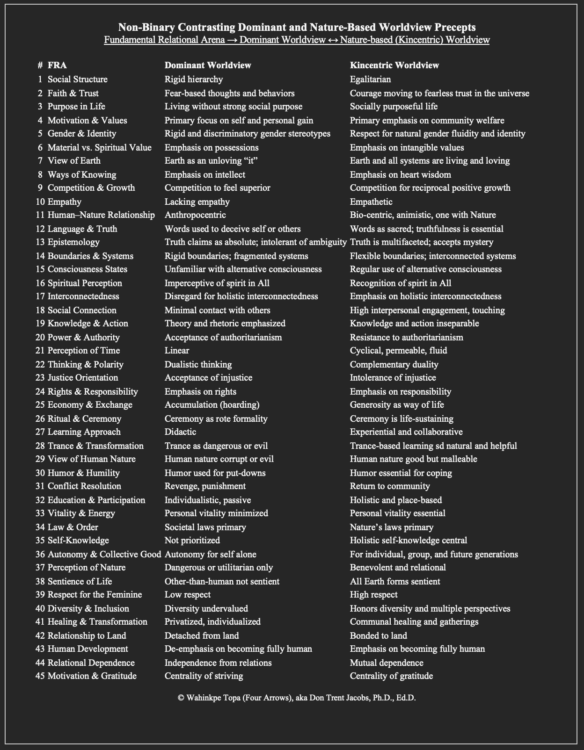
Worldview reflection on the two contrasting Indigenous and dominant worldviews helps families recognise the often‐unexamined and harmful values guiding their relationships, giving healthy options for rebalancing life systems. Are decisions being driven by ‘egalitarian manifestations’ or ‘rigid hierarchy’? Are they based on seeing ‘competition to develop positive potential’ or ‘competition to feel superior’? (See worldview chart at the end.) These contrasts can be drawn from Indigenous frameworks that foreground relationality, respect, responsibility and reciprocity (Cajete ; Little Bear ).
The FAWN component (Fear, Authority, Words and Nature) offers the original use of worldview reflection with self‐hypnosis. FAWN represents in general a number of the worldview precepts in the chart, which expand on FAWN with more precise beliefs. Every family, regardless of cultural background, navigates these forces. Most understand them via the dominant worldview lens.
 For example: Fear in the dominant worldview is seen as bad and avoided in the extreme, and when it cannot be avoided, it freezes most people or creates unhealthy reactions. The Indigenous worldview is very different. Fear is a gift for survival, but lasts only until one begins to practice the best virtue to respond, such as courage, honesty, generosity and fortitude.
Authority is generally external to individuals in dominant ways of being, whereas honest reflection on lived experiences is the main authority force for traditional Indigenous people.
Words in our colonial worldview are used for dishonesty and deception, whereas most Indigenous cultures did not originally have a word for it and see words as sacred vibrations. (See Tom Cooper’s book, A Time Before Deception.)
Nature in the Indigenous worldview is what humans are part of as interconnected, spiritual relations. Other‐than‐humans are teachers. The anthropocentrism of the dominant worldview has us at the edge of extinction.The CAT‐FAWN approach helps us reflect on how these concepts are constructed and expressed in both healthy and harmful ways.
FAWN can be used for metacognitive reflection in family therapy in many ways. Fear, for example, is often used in families as a behavioural lever, invoking punishment, shame or withdrawal to enforce conformity. This reflects broader societal norms that treat fear as a tool of social control (Fanon ). In contrast, families working through a CAT‐FAWN lens are invited to foster safety and belonging, where accountability arises through mutual care rather than through threat. Authority is also interrogated. Rather than assuming a hierarchical model of ‘parent knows best’, CAT‐FAWN encourages earned authority, grounded in wisdom, trust and relational responsibility (Brown ). The practitioner supports family members in reconfiguring roles where guidance and listening are reciprocal.
 Words, too, are examined. In many dominant therapeutic paradigms, verbal articulation is the primary currency of progress. But CAT‐FAWN acknowledges that deep truths are not always verbal. Silence, gesture, tears, laughter and ceremony all carry meaning. This echoes Indigenous and other global epistemologies in which knowledge is held and communicated in relational and embodied ways (Kovach ; Shotter ).
Nature, finally, is not just backdrop. Rather, it is co‐participant in the healing process. Many families, especially in urbanised or technologically saturated contexts, have become distanced from natural rhythms. A CAT‐FAWN approach reinvites families to experience themselves as part of nature’s cycles: rest, emergence, composting, regeneration. This ecological embeddedness supports regulation and connection (Abram ; van der Kolk ).
In therapeutic practice, CAT‐FAWN expresses itself through relational stance rather than rigid structure.
When doing CAT‐FAWN work, sessions may begin with grounding rituals—such as silence, breathing or naming intentions. The therapist cultivates trust not through expertise, but by offering presence, humility and listening. Power is shared. Emotional expression is welcomed, and silence is not pathologised. A parent who cries without words, a child who only gestures or a grandparent who sits quietly are each participating fully in the healing process.
Witnessing is a core principle. When a family member shares pain, others are invited to witness without analysis or solution. This is supported by research on trauma and relational attunement, which suggests that healing is often less about fixing than about being compassionately seen (Levine ; Herman ). A family system can slowly re‐pattern itself around a new way of being: one based on co‐regulation, trust and mutual respect.
Elements of ceremony may be integrated into therapy not as cultural performance, but as relational anchoring. Lighting a candle, passing an object for turn‐taking, naming ancestors or singing a song are all ways families across cultures have marked sacred space. Done with respect, such acts can decolonise the therapeutic space and return authority to the family’s own wisdom traditions (Gone ).
The therapist, meanwhile, is engaged in parallel self‐reflection. CAT‐FAWN is not a technique to ‘use on’ others. It is a relational and spiritual commitment. The practitioner asks the following: How do I enact fear? How do I relate to authority? What words do I trust? What is my relationship with nature? This inner alignment ensures that the therapist is not unconsciously replicating the very harms the family is trying to heal from.
Importantly, outcomes in this approach are not tied to measurable clinical metrics like reduced ‘symptoms’ or increased ‘compliance’. Rather, CAT‐FAWN invites more generative questions: Is there more tenderness? More eye contact? More safety in silence? More shared laughter or stories? These signs of healing may be subtle, but they are deeply embodied and often more enduring (Jordan ).
Ultimately, CAT‐FAWN offers a framework for relational repair that is as applicable to urban, multigenerational, neurodiverse or cross‐cultural families as it is to Indigenous communities. It does not prescribe; it invites. It does not fix; it remembers. In a world where many families have been fractured by systems of control, disconnection or domination, CAT‐FAWN provides a path rooted in ancestral wisdom, yet is open to all individuals to step onto a path that leads towards restoration, connection and right relationships with all (Table ).

REFERENCES
- Abram, 1996. The Spell of the Sensuous: Perception and Language in a More‐Than‐Human World. Pantheon.
- Brown, 2019. Dare to Lead: Brave Work. Tough Conversations. Whole Hearts. Random House.
- Cajete, 2000. Native Science: Natural Laws of Interdependence. Clear Light Publishers.
- Fanon, 1963. The Wretched of the Earth. Grove Press.
- Four Arrows, Cajete, and J. Lee. 2010. Critical Neurophilosophy and Indigenous Wisdom. Sense Publishers.
- Four Arrows, T.2024. “Restoring Sanity and Remembering Spirit in Psychology: Reclaiming Our Pre‐Colonial Worldview.” Review of General Psychology 28, no. 2: 106–122. .
- Gone, P.2013. “Redressing First Nations Historical Trauma: Theorizing Mechanisms for Indigenous Culture as Mental Health Treatment.” Transcultural Psychiatry 50, no. 5: 683–706.
- Hart, A.2002. Seeking Mino‐Pimatisiwin: An Aboriginal Approach to Helping. Fernwood Publishing.
- Herman, L.1997. Trauma and Recovery: The Aftermath of Violence—From Domestic Abuse to Political Terror. Basic Books.
- Jordan, V.2001. “A Relational‐Cultural Model: Healing Through Mutual Empathy.” Bulletin of the Menninger Clinic65, no. 1: 92–103.
- van derKolk, 2014. The Body Keeps the Score: Brain, Mind, and Body in the Healing of Trauma. Viking.
- Kovach, 2009. Indigenous Methodologies: Characteristics, Conversations, and Contexts. University of Toronto Press.
- Levine, A.2010. In an Unspoken Voice: How the Body Releases Trauma and Restores Goodness. North Atlantic Books.
- Little Bear, 2009. Naturalizing Indigenous knowledge: Synthesis aper. University of Saskatchewan Aboriginal Education Research Centre.
- Raz, , and M.Lifshitz. 2016. “Hypnosis and Meditation: Toward an Integrative Science of Conscious Planes.” Consciousness and Cognition42: 178–187.
- Shotter, 2011. Getting It: Withness‐Thinking and the Dialogical… In Practice. Hampton Press.
- Siegel, J.2010. The Mindful Therapist: A Clinician’s Guide to Mindsight and Neural Integration. W.W. Norton & Company.
- Wilson, 2008. Research Is Ceremony: Indigenous Research Methods. Fernwood Publishing.