
Childhood Evolved Nest Experiences: A Research Presentation
Childhood Evolved Nest Experiences: Relation to Adult and Intergenerational Wellbeing

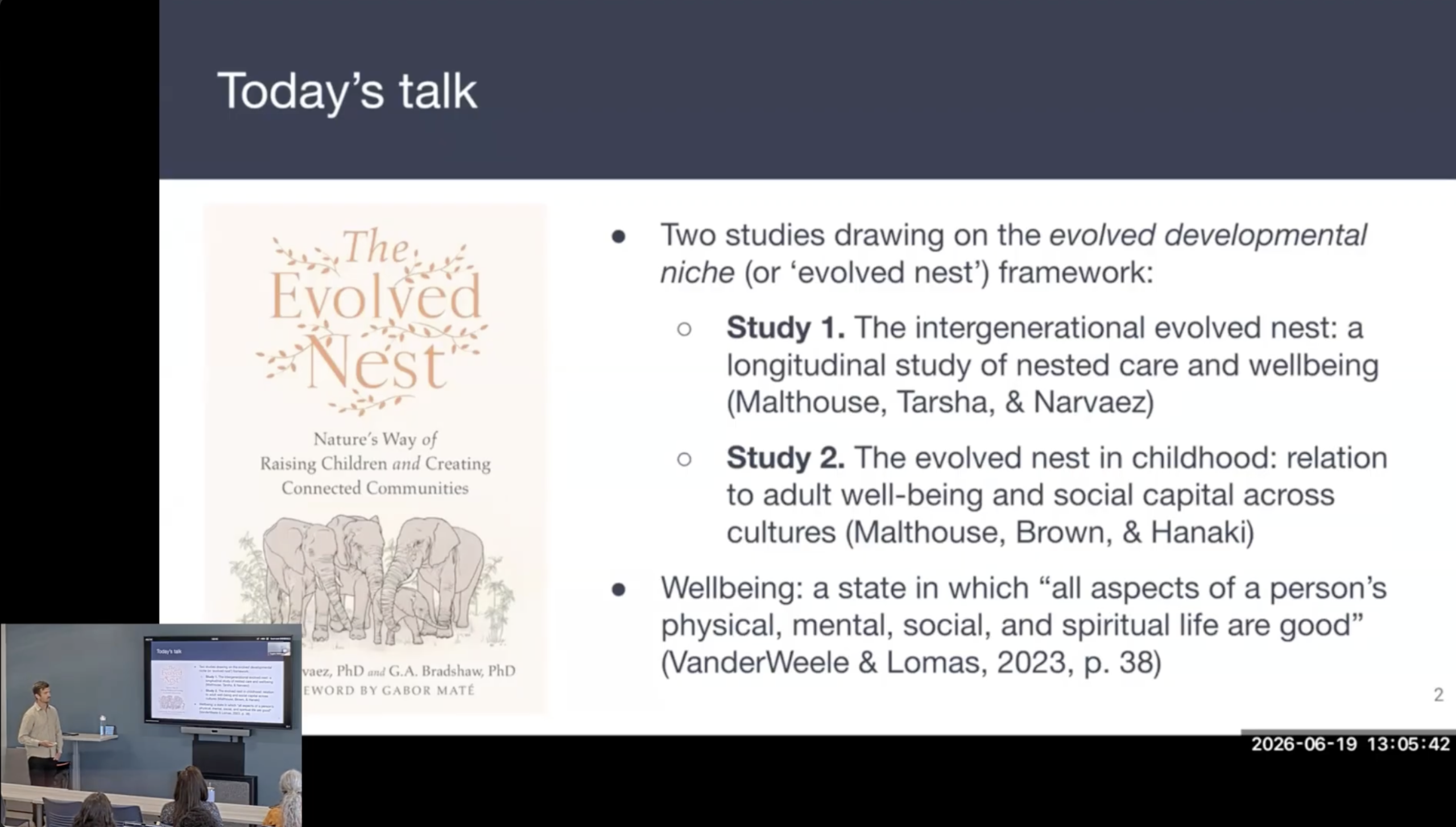
 Eugene Malthouse presents his research findings on the Evolved Nest impact on adult and intergenerational wellbeing at the Shaw Center for Children and Families at the University of Notre Dame. Darcia Narvaez introduces Eugene and his research for this presentation.
Learn more about the Evolved Nest on Kindred.
Explore the Evolved Nest Learning Center.
Abstract
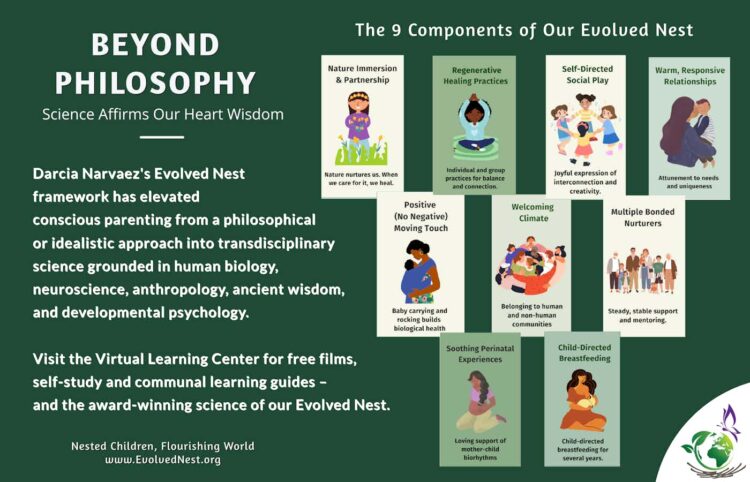
The human evolved developmental niche (EDN), or evolved nest, includes practices such as responsive care, self-directed play, and extensive affectionate touch, which meet the species-specific biopsychosocial needs of human infants. Previous research has shown that early life experience of these practices is associated with well-being during both childhood and adulthood.
In this talk, Dr. Malthouse presents findings from two studies that extend this research. Study 1 examined the relationship between childhood EDN experience and well-being across two generations using longitudinal survey data collected from US-based mothers (N = 222) at seven time periods during the first six years of their child’s life. Study 2 assessed whether recalled childhood EDN experiences were related to three dimensions of adult well-being and social capital (personal well-being, social relationships, and prosociality) in the UK, US, and Japan (n = 1,397). Findings from both studies indicated that childhood EDN experience has long-term benefits for both individual and societal well-being.
About the Speaker
Dr. Eugene Malthouse is a Research Fellow at the University of Nottingham, UK. His research focuses on the early life determinants of well-being and prosociality.