

Join the Nesting Movement:
Restore the Science of the People & Reclaim Our Nested Kinship
About the Origin Story Discussion with Darcia and Lisa…
In the discussion below, Darcia Narvaez and Lisa Reagan share the story of bringing together the transdisciplinary, holistic science theory of the Evolved Nest and Kinship Praxis wisdom in the new Nesting Ambassador Program. The program’s life-affirming strategies are practical and empowering, providing ambassadors with a healing journey, expansive resources for normalizing nurturing, and a global network and community.
The insights below first emerged during last summer, when a global beta-testers group moved through the components of the Evolved Nest together and shared their stories of integrating the baselines for human thriving into their own neurobiologies, families, communities, professional fields, and research. The beta-testing processes yield these main three insights:
-
The Learning Experience Versus the Lived Experience of the Evolved Nest. The Learning Experience of the Evolved Nest reverses the order of the nine components to create a trauma-informed, pedagogical framework. By sequencing for nervous system safety first, the reversed order of the nine components honors lived realities (including potential wounds) while equipping trainees to deeply engage the science and worldview. Read more about the Learning Experience of the Evolved Nest.
- The intentional design of the phrase, Nested Kinship. “Nested Kinship” was created to support the praxis learning experience of Nesting Ambassadors who no longer need to cognitively toggle between “Evolved Nest science” and “Kinship Worldview” in every conversation, checklist, or policy brief. One term encapsulates personal re-nesting and relational activism, community projects, and policy advocacy. The term also simplifies messaging to families, schools, workplaces, or healthcare—e.g., “We’re building Nested Kinship in our community” instead of explaining two frameworks.
- Closing the Theory-Praxis Gap. The recognition of the Nesting Ambassador Program’s capacity to close the Theory-Praxis Gap between the holistic science of our Communal Evolved Nest and regenerative, trauma-informed action through Kinship Praxis.
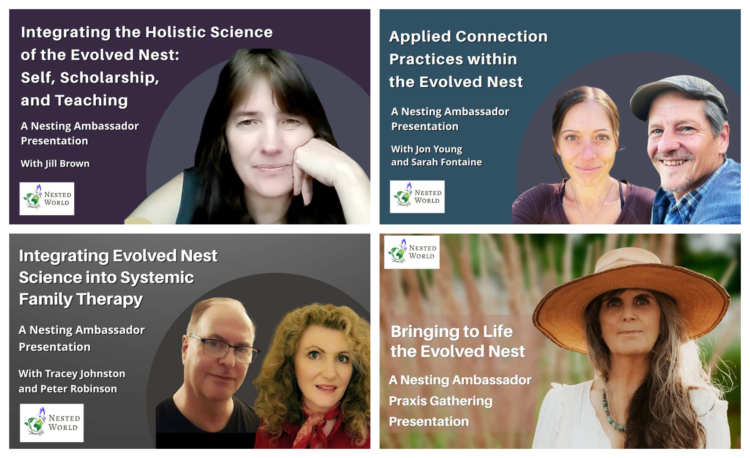
As all we do at Kindred is intended to work with the life-affirming emergent, we expect more insights in the coming months and years as the Nesting Ambassador Program expands. For now, many Nesting Ambassadors are sharing their stories of integrating Nested Kinship in their Field Reports and presentations to new cohorts. You can read their “Field Reports” on Kindred and on the Nested World website. The new Nested World Initiative launched the Nesting Ambassador Program’s first inaugural cohort in January 2026. We hope you will join the forthcoming Nesting Ambassador Fall Cohort. Applications are being accepted now.
Please consider joining us in this fall’s cohort.
Warmly,
Lisa Reagan
Kindred Editor
Kindred World Founder
Watch the Nesting Movement Discussion with Darcia Narveaz and Lisa Reagan
Join the Nesting Movement:
Restore the Science of the People & Reclaim Our Nested Kinship
(An edited transcript of the video discussion above.)
The Importance of Restoring Human Baselines for Thriving
Lisa Reagan: We are on the other side of beta testing the Nesting Ambassador Program (last year) and our first inaugural cohort is graduating this month. So today, we’re going to take a moment and have a little story time about the long history and intentional origins of the Nested World Initiative. This historical overview will help us develop a deep appreciation for the mission and vision of Nesting Ambassadors.
So… I thought I’d start with sharing the story of the first lecture I saw you give on baselines, and how we’re missing baselines for wellbeing as a species. You used the metaphor of the oceans and how humans were not using the correct baselines to measure pollution, so we really didn’t know how bad things were. And this week, I thought about that lecture, because our government is now getting rid of the critical ocean observation systems that monitor the climate crisis.
Darcia Narvaez: Yeah, the story is about shifting baselines, that in oceanography and marine biology. People assumed that whatever the oceans were like when they were growing up, that’s the way they should be, and that’s just normal, and healthy. But, they discovered, though, that that doesn’t work. It’s not an appropriate measure or guideline.
A study in 2006 replicated a study from the 1950s, where they took a boat from California to Hawaii, and every little while, they put a bucket over the side of the boat and pulled it up. And in the 1950s, the bucket would come back full of fish. In 2006, the bucket would come back full of plastic. And so, there’s a shifted baseline. You can’t assume that it’s normal to have oceans with all this plastic in them, and not fish.
What’s happened in science in general, I think, in philosophy and Western scholarship, writ large, is that we forgot what’s normal for our species in so many ways. What’s normal human nature? What’s normal to raise human nature? What’s normal for getting along and what human personality is like? So that’s what, the Evolve Nest and the Nested World Initiative is all about: getting back to the correct baselines and honoring them.
Lisa Reagan: And what are these baselines, just in case anyone’s tuning in who does not know.
Darcia Narvaez: So the baselines for human nature are: to be cooperative, and enhance the well-being of others, and be very socially skilled, and have all these intelligences that help you move through the world responsibly, and respectfully, and honoring the natural rhythms of the cosmos, really, and, you know, enjoyment and playfulness. And human nature, then, very intelligent, very wise as you grow into your adulthood.
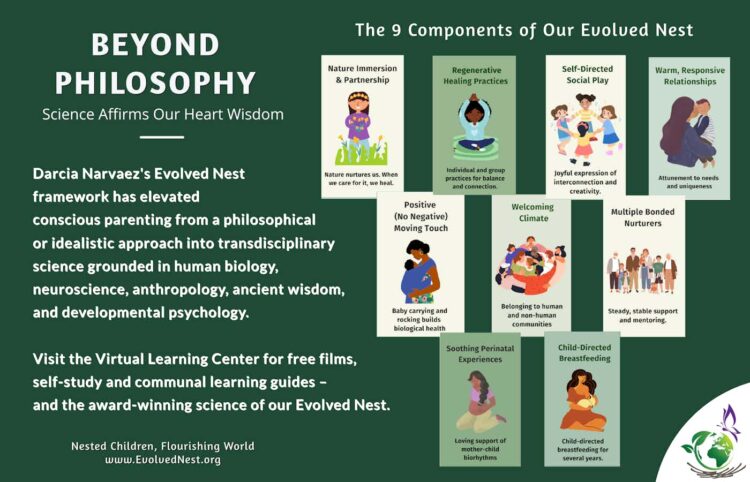
And how do you get there? Well, our species, like every animal, has a nest, a developmental system, for fostering that nature of that creature, of that organism. Our human nature is fostered by our Evolved Nest. The practices, starting with infancy, are:
- Soothing perinatal experience, where mother and child feel supported in pregnancy, at birth, no separation, just ongoing connectedness, and enjoyment of one another,
- Breastfeeding, child-directed for several years.
- Then Multiple Nurturers, so baby needs 24-7vtouch and responsiveness, because their brain is growing so quickly. And that requires, as we evolved to have multiple nurturers, not just a mom doing this alone, or mom and dad, but a community of support, the village, right?
- The village is our Welcoming Social Climate.
- And then, to have Playfulness, to include playfulness in all you do throughout life, so that the evolved nest is for all of us throughout life.
- And touch, affectionate touch, or Positive Touch from
- Responsive Relationships,
- And Nature Immersion, Connection, and Partnership,
- And then Regular Restorative Healing Practices, because we get off-kilter every now and then, mentally, physically, relationally, getting back in tune with the cosmos, with our community, and with ourselves.
Healing the Bio-Cultural Conflict: The Origins of Evolved Nest Holistic Science
 Lisa Reagan: What I witnessed when I first started doing the work in the Conscious Parenting Movement, as we called it decades ago, was what you just listed, the nine components of the Evolve Nest, were scattered all over the place, in different silos of science and advocated for by various activist groups. The breastfeeders were here, the birthers were there and parents had to pick and choose which biological imperative they had time to study and implement by themselves.
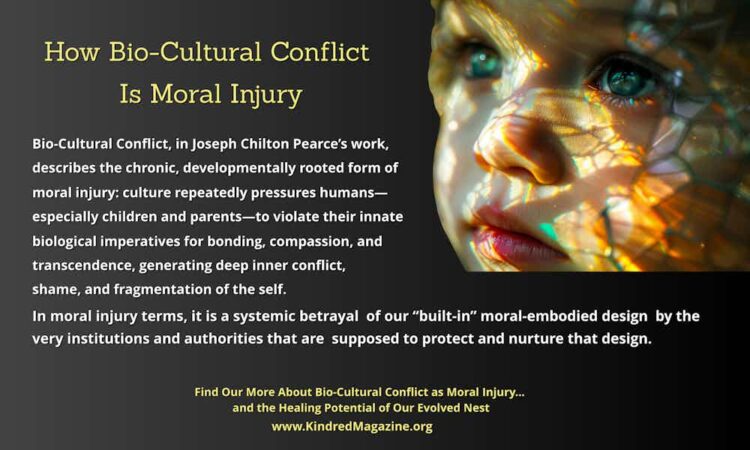
Joseph Chilton Pearce told us, warned us, parents find themselves thrust into, his words were “the hell” of a Bio- Cultural Conflict in modern culture. Parents are forced to pick and choose between which biological imperatives you’re going to be able to fulfill, and what cultural imperatives, like going to work and making money to pay rent, you cannot skip. So, changing the culture by normalizing nurturing became a part of Kindred’s nonprofit mission.
But what you found changed our understanding of the inevitability of the Bio-Cultural Conflict and gave us the holistic science to change it. I want to say the 2010 Notre Dame Symposium was a turning point for the conscious parenting movement, now the Nesting Movement. In hindsight, this event feels like a pivotal moment in time when the Evolved Nest lens, with assistance from the scientists and researchers who spoke at the symposium, started coming into focus. People like Jim Prescott and Vincent Felitti, the founding ACES researcher, spoke. So, there was a gathering of world renown scientists who were stewarding their field’s specialty in what would become recognized as the Evolved Nest.
But there was one scientist who was bringing together the coherence of our Evolved Nest, a coherence capable of dismantling the Bio-Cultural mythology and bringing empowerment, affirmation, and guidance to parents, to our nonprofit work at Kindred World, and to the human family. And – I said I wasn’t gonna cry! I’ll try not to (but cries).
Darcia Narvaez: Yeah, well…It’s just been a lifelong quest of mine since my first memory to figure out what’s wrong with the world and how do we fix it. And I especially got moved in, 2002, 2003, when the United States went to war with Iraq, and I could not understand how people could go do such a thing on no evidence, essentially.
And, then I was reading widely, trying to figure this out, and found anthropology, the ethnographies, hunter-gatherer childhoods. I found Allan Schore, interpersonal neurobiology. I found Jaak Panksepp’sAffective Neuroscience, and how our mammalian brains work, and how we match up with other mammals, and what we need, and…anyway, it all came together as, like, BING! Ugh, this is what we need to counter, to actually restore our human nature, which is cooperative. It’s not aggressive and selfish and violent, all these crazy ideas that have been purveyed by the dominant culture. And so, yeah, I had to bring in people, and I invited Allan Schore and Jaak Panksepp to help me organize the first conference. We had several conferences at Notre Dame, but the first one, they invited all their friends. (Watch playlists of Darcia’s Notre Dame Symposiums on the Evolved Nest YouTube Channel: 2010, 2012, 2014, 2016.)
Healing the Bio-Cultural Conflict: The Praxis Origin Story
Lisa Reagan: So, let me explain my tears for people who haven’t seen me cry about the Evolved Nest before. That same year, in 2010, we co-sponsored a three-day conference in Washington, D.C., with a very elderly Joseph Chilton Pearce as our keynote. Bruce Lipton was also there. Six hundred people attended. It was a sold-out event.
 The title of the conference was Freedom for Family Wellness. Kindred was founded in the middle of America’s 50-year decline to the bottom of all international indices for family wellness. Our nonprofit served parents who were driving themselves crazy with this pursuit of, how do I create wellness for myself? How do I create the wellness culture and community my family needs? And we were doing it without the holistic science lens that you created, just silos of information that were not easily found or culturally sanctioned. We did not have a coherent, unifying story of ourselves a a human species. Nor did we have the language.
We were told, by social scientist Paul Ray, that marketing research showed people who pursued holistic wellness and sustainability around the world were considered Cultural Creatives: also known as oddballs, weirdos, and counter culture radicals. In my interview with Paul Ray, he tells us to “find coherence and create visibility” for our work. So, we took that identity on, like, okay, well, I guess we’re just odd, we’re just weird. But it was with a commitment to create a different world for our children.
Creating the Worldview that Created the Evolved Nest Lens
Lisa Reagan: So, when you held these symposiums and assembled what would become a transdisciplinary lens of holistic science, you finally published much of your findings in the book, Neurobiology and the Development of Human Morality, the book that started it all. I’m especially looking at the subtitle, Evolution, Culture, and Wisdom. And we, as parents and activists, definitely experienced the lack of wisdom in our culture. How did you bring together this holistic scientific lens? It seems like you had a worldview that did not reflect the Dominant Worldview of academia, honestly.
 Darcia Narvaez: Well, I grew up, half my childhood outside the United States, and so I always had a broader perspective than people who only stay in the United States, generally speaking. And I couldn’t understand when we would go away for a year and come back for two years, and then go away for a year, why there was so much injustice, and so that became my childhood quest for life. But I also had a lot of interest. I was a music major in college, and I did classroom music teaching in the Philippines, and then I was a Spanish teacher in middle school, and I had my own business, and I went to seminary to try to answer the question, what’s wrong?
Of course, there, the answer there was, oh, it’s original sin, people are just basically bad, and that’s what’s wrong. Fallen, et cetera, et cetera, and it’s like, no, no, no, no.
And then I, ended up, finding the field of moral development research, and I thought, Aha! They’re gonna help me answer that question. And so that’s how I, began my academic career.
But got tired of just looking at a very narrow slice of morality. And that’s why I was so… I mean, I was already coming in interdisciplinary, right, and thinking outside the box, and then, you know, when you read widely and you listen to all sorts of other disciplines, you understand the world is much more complicated than this little narrow silo that you were trained in.
So that’s how it began, and again, it’s that concern from a young childhood for the well-being of children that…just followed me. For decades, forever. Still now, right? It’s like I cry over the babies of the world, so…
Lisa Reagan: Yes, your worldview was shaped by international travel and exposure to different cultures, that was a critical component. I know worldview is expanded and shaped with travel and exposure to different cultures.
Darcia Narvaez: Yes, and I forgot to say about the book. I was invited by Allan Schore to write for the series, Interpersonal Neurobiology, the book series. I presented a proposal that was on the neurobiology of moral development. And then while I’m writing the book, the book had a mind of its own. So, well, what’s the solution? Well, you gotta look at evolution properly, which is evolutionary systems, not just genes. Genes are just one little thing that we inherit. We inherit a whole bunch of other things, including a developmental system for raising the young.
And then, where do we find the solution? Well, culture, indigenous wisdom, Indigenous culture that, you know, has been in existence for millions of years. And then, wisdom is what comes out of that. The evolved nest, understanding that the worldview comes out of the evolved nest, and the evolved nest leads to wisdom. So anyway, it’s all in there, the beginnings of all this, yeah.
Lisa Reagan: Yeah. Wisdom. That we are designed for wisdom when we are nested.
Darcia Narvaez: That’s right.
Lisa Reagan: Wow, that is, the antithesis to the message that we’re given in our patriarchal culture.
Darcia Narvaez: Yep.
Academic Barriers to Holistic Science and Normalizing Nurturing
Lisa Reagan: In bringing the transdisciplinary and holistic science of the Evolved Nest forward, you did encounter some issues, like the chapter on breastfeeding wasn’t allowed to be included in the book, Neurobiology and the Development of Human Morality. Can you talk about that?
Darcia Narvaez: Well, in general, the Evolved Nest is not a welcome piece of information to people who have devoted their lives to one little silo, for example, and that’s what they study. And so, we find that it’s really hard, for some people to welcome the information.
And, yeah, a lot of doors closed and are not opening, to publishing this information.
Lisa Reagan: Yes, but I have read that science is headed into the direction of integration, so you’re just on the edge there, you’re just working with the emergent —
Darcia Narvaez: Yeah, there’s not a lot of incentives for it. It’s hard still. We have a couple of young scholars who are very interested, so we’re very hopeful now. (Watch Eugene Matlhouse’s research presentation.)
What Else Is There? The First Threshold Crossing of a Hero’s Journey
Lisa Reagan: There is a name for what is happening here, and is now being actively pursued in the Nesting Ambassador Program, and it’s called the Theory-Praxis gap.

This is a known phenomenon in science, and people who have watched all kinds of scientific discoveries in health, for example, witness the hurtles science must cross, and may never cross, to put the research insights and developmental wisdom into praxis, into the practical realm of everyday life where the theory could be accessible to and benefit the people. Some of the people who are the very best at closing the Theory-Praxis Gap are nurses, because they’re the ones that are on the forefront in actually implementing the science, witnessing if the theories work, and listening to feedback from the people they serve.
There are fields of studies around this, and what they show, though, is when you are conscious of trying to take a holistic scientific theory, like yours, this emergent, transdisciplinary, holistic, scientific theory, and bring it to people who are hungry for it. And the people who have been showing up to Kindred for all these years, including myself, have always askeddem the same question: If I don’t do what they tell me, which feels wrong and isn’t working (like letting the baby cry-it-out), what else is there?
I took time to unpack that question in the Parenting as a Hero’s Journey program because the question is “the call”. It’s the Hero’s Journey call to go find out what else is there. So, we know when those Cultural Creatives are coming through the door here, and they’re following this call, they have a sense there is something else, and we feel like…we feel like you’re affirming us, Dr. Narvaez. You’re telling us something that we already feel in our bones is true, but we don’t have the language for it. We don’t have the scientific scaffolding that we need to transform our families, our own neurobiology, our communities, our fields of study, and our professional fields.
We now have baselines for human thriving. The Evolved Nest is the Science of the People, on many levels of meaning. We now have language, and tools, to understand the Kinship Worldview that is possible when we are nurtured as a human species.
And all of the closing of the Theory-Praxis Gap, of following this call to a Hero’s Journey to find out what else is there? This work is being courageously taken up by parents, professionals, researchers, and community activists participating in the Nesting Ambassador Program.
This is the point of our story telling time today. I want to convey the tremendous amount of intentional exploration and commitment to the human family the Nesting Ambassador Program brings together in its five-month long journey and training. What we are working together, as a global network and community, to discover together is, not only what else is there? But what is possible.
Grieving Our Way Home
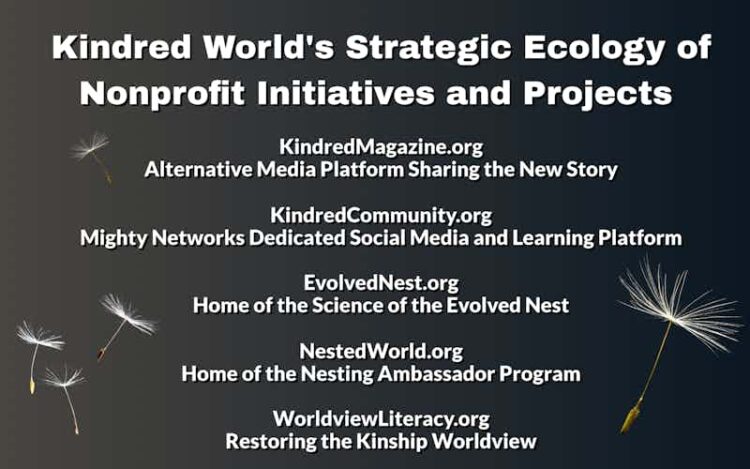
Lisa Reagan: We worked with two dozen people last summer in the beta testing group who helped us to figure out that we can’t just have people study the Lived Experience of our Evolved Nest. We have to create a Learning Experience of the Evolved Nest. One that grounds us first in worldview literacy, and then Nature Connection, Restorative Healing Practices and Play (to exercise our imagination muscle), because we haven’t experienced our nest in so long. Discovering our need for nestedness can be empowering, but also inspire a deep grieving experience.
Can you speak to that? The grief around discovering our Evolved Nest.
Darcia Narvaez: Yes, I think that’s what we have a lot of in the unnested culture…a lot of grief, because we didn’t get what we needed from early on in babyhood, and then throughout childhood, because it’s such a coercive, unresponsive culture. The dominant culture that puts money first and work over relationships and love and generates, then, a biology of fear. And then that fear is then also covering up the grief that’s there from the loss of relationship early on that you expected.
And so, yeah, it’s really hard for people to open up the gate, the cage where they’ve held all those feelings to try to just survive, building a big, fat ego as a cushion against feeling all those babyhood feelings, which make you feel like you’re in the abyss. You’re falling down, you’re gonna die forever. That’s how a baby feels when they’re left alone to cry. That deep despair. And so, it’s a difficult shift, but when people have been buffeted by circumstances and suddenly have an awakening in their awareness that this is not the way things have to be.
Like, if they go to Africa and live in the village for a while, or someplace, then they come back. It’s like, why are people like the Dalai Lama said when he first came to the United States? What’s wrong with everybody? Because everyone’s depressed, everyone feels lack of confidence, you know, insecure, deeply.
And so, there’s a lot of grieving to do, and so we have revamped the Nesting Ambassador Program order of components to start with healing practices and Nature Immersion, that’s where we get our energy and our healing and our support, even if we don’t have it with humans. And then, Regular Healing Practices to get back into balance as we go through all the rest of the material. These are tools that we can use to calm ourselves down, to feel real readily connected to the cosmos, because we’re always connected. We just forget that. Our perception is misguided. So that’s what we’ve done.
Restoring Our Kinship Worldview

Lisa Reagan: So, talk for a minute about Four Arrows’ work. You and he started working together a long time ago. The work that you can find out there, the papers that you wrote together, inching towards our original Kinship Worldview and now, Nested Kinship, as we’re trying to call the result of bringing together the Evolved Nest and Kinship Worldview. How does his work fit into the Evolved Nest Science?
Darcia Narvaez: Well, he was one of the nudges, his work was one of the nudges that moved my neurobiology book into the Indigenous perspective, because I heard him at a conference in 2010, right when I was writing the book, and, was like, of course, this is it! And then he and I organized a conference at Notre Dame in 2016, and we wrote a couple things together.
Because the Evolved Nest is how we get to the Kinship Worldview. Contrasting the Kinship Worldview with the Dominant Culture’s Worldview is a way for adults to realize, oh, I like that Kinship Worldview list, but I’m over here. What can I do? And so, there’s a top-down way of transforming ourselves, and then the bottom-up way, of course, is to raise the young so that they naturally develop the Kinship Worldview.
Lisa Reagan: Yes, that is such a beautiful realization and a container for doing the work that we’re doing, this Worldview Literacy. I had become a Worldview Literacy facilitator through the Institute of Noetic Sciences, IONS, years ago, before I knew of your work and Four Arrows’ work, and there was no mention of early human development.
I did have a discussion with one of the scientists there, whom I adore, and I adore all of them, in their garden one night, and I said, you know, why are you guys not looking at babyhood and prenatal life. And they just said, oh, well, you know, we haven’t gotten around to looking.
So, Four Arrow’s scholarship on Indigenous/Kinship Worldview has been very clarifying for me, and helpful in teaching worldview literacy, to say, there’s two. There are two worldviews. Our consciousness is our consciousness, and our worldview is our vehicle for our consciousness. Our Dominant Worldview programming, and our Kinship Worldview, which is who we are when we are nested.
Darcia Narvaez: So, we want to decolonize our child-raising, and decolonize our minds as adults, and rewild ourself, get back to being earthlings, respectful, responsible earthlings, connected always, never disconnected, never isolated. We shouldn’t be doing that ever to a baby, because that has a significant imprint on their security, and then forever after, their trajectory can go towards bracing against life, because it gets triggered into feeling threatened. And then your blood flow shifts and you can’t think very well because your body’s mobilizing you for running away or fighting. So you have to make sure there’s zero separation at birth, that birth is soothing. I mean, just a few hours separated from mother after birth has long-term effects on emotion and social capacities.
Lisa Reagan: Yes, wow, and…
Darcia Narvaez: And now…
Our New Wellness-Informed Story: Field Reports from Nesting Ambassadors
 Lisa Reagan: Now, we’re at the place the ocean is. We’re collectively just not going to look in that direction anymore. And if we do, we don’t have the lens to look through. But some of us are looking. And now we have a lens to see ourselves. So, I do feel like the Evolved Nest science provides us with missing baselines to assess ourselves and make a plan of action.
Darcia Narvaez: And the Evolved Nest science is transdisciplinary, so it’s bringing together all sorts of sciences. The evolutionary systems, which is broader than genetics, neuroscience, clinical science, developmental science, education science, all these coming together, under… with an understanding of what is species normal. And how do we get there?
Lisa Reagan: How do we get there? And, you know, for a long time at Kindred, we’ve said we’re sharing the new story. But what a new story this really is now, to be able to help ourselves shift our identity.
And to say this old story that you brought up in the beginning of our discussion of, oh, we’re just, you know, sinners, or, you know, we’re just, you know, not very good people. And to say, no, that’s not true. When we have our nest in place we’re very wise, and we know how to be relational and live in harmony with life. And this is who we really are.
Darcia Narvaez: And that’s the wellness pathway, right? You provide for the young, meet the basic needs, actually meet basic needs of everybody throughout life, but especially important in early life so that they develop a very healthy neurobiology, sociality, morality that’s inclusive and not exclusive, and then they develop thriving and the ability to get along with others, and live a regenerative lifestyle so that they’re living in cooperation with the rest of nature as well. That’s the wellness-informed pathway.
Lisa Reagan: Yes, it is. I love the trauma-informed movement. It has been so helpful in the United States, but when you started recording lectures on what is wellness-informed, I realized what a gap I our perception, of what is wellness-informed, the Evolved Nest fills. We can ask about the pathology of trauma-informed, and count our ACES, from a Dominant Worldview, but what is the plan for wellness? That plan emanates from a Kinship Worldview through Evolved Nest science.
We have your wellness-informed lectures and more on sharing the Evolved Nest science in a trauma-informed way on the NestedWorld.org website. An integrated wellness-informed and trauma-informed approach helps people to share the Evolved Nest science with compassion.
On the Nested World Initiative website, the Nesting Ambassadors are letting us know how their New Story creation, the closing of the Theory-Praxis Gap, is going in their Field Reports.
Read the Nesting Ambassadors’ Field Reports
Darcia Narvaez: Yeah, so a lot of good stuff, and we hope more people will join us to share the wisdom that we have received from on high, really.
Lisa Reagan: Yes! Relational. Relational intelligence. Thank you so much. Thank you so much, Darcia, for all of your work. Thank you for being here with us on this grand adventure. I look forward to this next year together with our Nesting Ambassadors.
Darcia Narvaez: Amen. Thank you, Lisa, for your partnership and for your leadership.