
Tonight, I cried… I cried, and my body released an overflow…
These tears mark the breaking point in the face of a systemic reality: the way our current society treats childhood constitutes a fundamental flaw in our humanity.
 The primary cause of this distress lies in children’s radical disconnection from the Living World, which I observe as a facilitator of Deep Nature Connection. Confined to indoor spaces and saturated with screens, they grow up in profound ignorance of Nature and disconnected from their bonds with it. Between the ages of 6 and 10, the average child cannot identify more than two species of birds, yet they can easily rattle off brand names or virtual characters. Orienting oneself by the cardinal directions, observing animal tracks, or the simple ability to sit in silence for five minutes to listen to one’s senses are skills that have been lost. I am always saddened to see the skepticism that takes hold of them when I mention the possibility of communicating with plants, hugging a tree, or practicing gratitude toward living things… this reflects a rupture in the ancestral bond between humans and their environment.
This disconnection is linked to a second tragedy: the explosion of internal violence in children, which is directly related to the pervasive violence in this society. Lacking quality time with their attachment figures—often reduced to just a few hours at the end of the day—and in order to meet adults’ expectations, children sacrifice their authenticity to preserve a precarious bond. This emotional insecurity turns into anxiety, pathological shyness, or explosive aggression, mimicking the normalized violence they absorb through the media and their environment. I have witnessed, in educational and family settings, this silent suffering, these moments of distress where adults’ inaction implicitly validates the norm of “ordinary educational violence.” Yet let us remember that all violence is a symptom of unacknowledged pain…
This violence is transgenerational. It is the toxic legacy of parents who are themselves traumatized, repeating patterns they never had the opportunity or the courage to heal. Caught in a vise of stress, loneliness, and social pressures, modern, exhausted parents become the unwitting carriers of this chain of suffering. Lacking models of emotional regulation and the time for their own healing, they pass on to their children a legacy of reactivity and disconnection.
This observation extends to the very architecture of our “acultural” society. We have normalized the abnormal: segregation by age, confinement in sterile homes that isolate us, early separation of mother and child, industrialized food, and the primacy of work over human connection. Within this system, “anti-social” networks become the sole refuge for connection, paradoxically marked by toxicity and verbal violence that reflect the state of collective disarray.
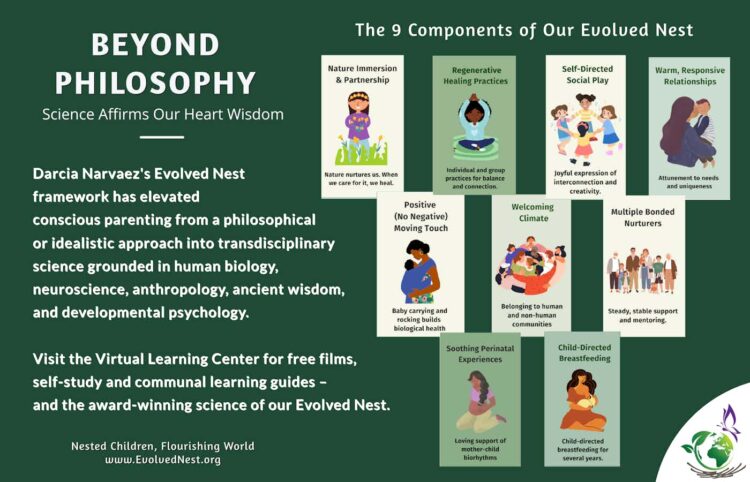
Faced with this bleak picture, the solution does not lie in tweaking superficial educational methods, but in a radical return to our evolutionary biology. As theorized by psychologist Darcia Narvaez, we must rebuild the “Evolved Nest.” This developmental nest, essential to a child’s neurobiological and emotional health, is based on nine components that our society has eroded:
The Lived Experience of the Evolved Nest (see the Learned Experience here.)
- Nature Immersion and connection
- Regular healing practices
- Prompt and warm responses to the child’s needs (not letting them cry).
- Years of breastfeeding on demand.
- The constant presence of several nurturing adults (the role of the “village”).
- Positive physical care and gentle touch on a daily basis.
- The freedom to play independently with children of various ages.
- Soothing perinatal experiences.
- A welcoming environment
Recognizing this lack is painful, especially when it collides with the reality of our own children and the difficulties and suffering they may experience. However, neuroplasticity and the ability to repair the attachment bond offer tangible hope. Secure attachment can be rebuilt through patience, compassion, love and play.
We stand at a crossroads. Millions of years of evolution cannot be erased by a few centuries of industrial disconnection. The need for this “Evolved Nest” remains ingrained within us, accessible through our deepest intuition. While exhaustion in the face of a sick society may tempt us toward exile or withdrawal, our collective responsibility calls on us to work, here and now, to reweave this bond. Showing our children that another reality is possible—one rooted in the wisdom of Indigenous peoples and respect for all living things—is not an option, but a vital necessity for the future of humanity.