


The challenges we see in classrooms today may begin long before children arrive at school, shaped by early development, caregiving, and the conditions of modern life.
By Dan Warren, Ph.D and Amy Warren, Ph.D.
 When a recent New York Times Magazine article (“America’s Children are Unwell. Are Schools Part of the Problem?”) examined the growing distress among children and raised questions about the role schools play, it captured a widespread sense of concern shared by teachers, parents, and administrators alike. Classrooms feel more unsettled. Children seem more anxious, less regulated, and less able to manage the demands of school. Teachers are exhausted, discipline feels ineffective, and learning appears harder to sustain.
It is tempting to locate the problem squarely within schools themselves. We could point to outdated curricula, underprepared teachers, and inconsistent discipline. There is real validity in these concerns. Schools do have limitations, and in some cases, they do fail to meet the needs of children in front of them. But this explanation stops too soon. Schools did not create the conditions they are now being asked to manage; they inherited many of them.
For much of the modern era, schooling operated on an assumption: that children arrived at the classroom door with a basic developmental foundation already in place, shaped in the earliest years of life. Capacities like emotional regulation, physiological stability, early attachment, and emerging social competence were expected to be largely in place by the time children entered school. Schools were built on top of that foundation.
Increasingly, that assumption no longer holds.
The cracks in school have always been present, reflecting the inherent limits of a model designed to build on capacities children were expected to bring with them. Stronger early developmental foundations once helped absorb those limits. As those foundations have weakened, the limits of the system have become more visible. Children’s starting points as they enter school have shifted, shaped by changes in the environments of their earliest years.
If we trace this shift backward, all the way to birth itself, the picture becomes clearer. Human development begins in relationship, through continuous contact, responsive care, and co-regulation of the infant nervous system. In these early stages of life, the foundations for regulation, attention, and social engagement are built through repeated experiences of connection and support.
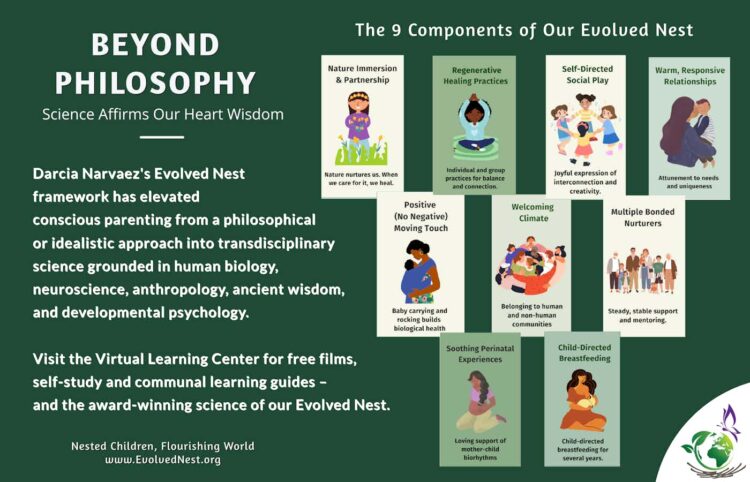
Developmental psychologist Dr. Darcia Narvaez describes the conditions that support this process as the “Evolved Nest,” a set of relational and environmental supports that includes responsive caregiving, physical closeness, free play, and a network of stable, attuned caregivers. These are the conditions under which human children have developed across most of our evolutionary history, and the conditions their brains expect.
Yet many of the systems shaping early life today are not designed around these developmental needs. Birth and early infancy are often treated as medical events to be managed efficiently rather than relational processes that require time, continuity, and protection. Hospital practices around delivery, feeding, and early bonding often prioritize speed, standardization, and risk mitigation. Caregiving is more fragmented, and families increasingly isolated. When these early conditions are disrupted, even subtly, it can affect how the developing nervous system learns to regulate stress, adapt to novelty, and engage with the world.
From there, many children move quickly into childcare environments that are well-intentioned, yet often misaligned with the needs of developing nervous systems. Care organized around roles, institutions, and time; high child-to-caregiver ratios; physical separation from caregivers; and limited opportunities for deep, stable attachment and consistent, attuned care elevate baseline stress levels for infants and toddlers. Even in settings where care is responsive, children are often separated from the flow of everyday relational life, spending long stretches of time in designed environments that are structured, segmented, and largely removed from the rhythms of shared human experience.
Children are remarkably adaptive; they adjust to these conditions. But adaptation is not the same as thriving. It carries a cost.
By the time these children arrive at school, they are expected to function within a model that assumes capacities for sustained attention, emotional regulation, delayed gratification, and complex social navigation. These expectations are better supported when early experiences have reliably fostered the development of those capacities. Today, the gap between what schools expect and what many children are prepared to do has widened. The mismatch is now more visible, and is often narrowly interpreted as a failure of schools themselves.
Teachers feel this mismatch acutely. They are asked to navigate increasingly complex classrooms, drawing on behavior management strategies, social-emotional curricula, trauma-informed practices, and a growing array of accommodations. Yet many describe a persistent sense that these tools do not fully address what they are seeing: a mismatch between the level at which we are intervening and the level at which these challenges begin.
The behaviors that disrupt learning in school today are often rooted in physiology and early development. When children struggle to sit, focus, tolerate frustration, or regulate emotion, we are often witnessing the downstream effects of early environments that did not fully support the development of those capacities. These responses reflect how the nervous system has adapted to earlier conditions, becoming more reactive, more vigilant, and less flexible in responding to experience, shaping how children respond to stress, attention demands, and social interaction in the classroom.
The challenges showing up in schools reflect broader shifts in the conditions of early life. Many families today are navigating economic pressures and cultural expectations that prioritize work over presence. Extended family networks and community-based caregiving have thinned, leaving parents to carry what was once shared. Medical systems have increasingly prioritized efficiency over developmental continuity, and policy decisions have made it increasingly difficult to provide the time, stability, and relational support that young children need.
From a longer view, these shifts represent a growing distance between how human development evolved and the conditions in which it now unfolds. For most of our history, children were raised within dense networks of relationship, embedded in daily life, and supported by multiple caregivers who shared responsibility for their well-being. This kinship-based way of organizing care fostered a more relational, socially attuned, and ecologically connected way of being. Today, many children are growing up in environments that are more isolated, more structured, and more shaped by institutional demands, creating a significant tension between biology and culture.
Collectively, we have built this reality.
The structure of school relies on capacities that begin developing long before a child enters a classroom. When early developmental foundations are strong, they can help absorb the structural limitations of schooling. As those foundations have become less consistently supported, the developmental load placed on schools has grown heavier than the model was designed to carry.
There is a path forward, but it begins upstream. Schools can and should improve, and teachers need support that reflects the developmental realities of the children in front of them. But lasting change will require widening the focus beyond the classroom. Families need economic and social conditions that make early parental caregiving possible. Medical systems deserve scrutiny through a developmental lens. Policymakers and employers must recognize that supporting parents is a long-term investment in societal well-being. Much of the foundation for learning is already laid—or not—long before a child enters a classroom.
Dan Warren, Ph.D., is Director of Youth Development & Education at Fluent Research. He previously spent over a decade as an elementary school teacher and has worked extensively in child development research and educational practice.
Amy Warren, Ph.D., is Senior Child Development Researcher at Fluent Research and Co-Founder of Home Base Learning Center, a nature-based elementary school. Her work focuses on the earliest foundations of human development, informed by years of hands-on practice as a doula supporting families through birth, postpartum, and early parenthood.