
From Grief to Vision: A Trauma-Informed Path to Sharing the Evolved Nest Through Peacemaking
Justine Collet Integrates Designing for Peace for Kinship Praxis
 Adobe/Lois GoBe
In this state of urgency, it is easy to aggress, argue, or dismiss where others are in their own journeys. We may forget to respect their pace, driven by our own fear for the future. Yet convincing never happens through aggression. True change—the kind that sticks and transforms—arises through listening, respect, connection, patience, compassion, and peace. And most importantly, through sharing our own stories.
While science and data show how humans are designed to thrive, our stories answer “why should I care” by translating raw facts into human experience. During our Nesting Ambassador training, autoethnographic writing helps us reflect on and connect our stories of nested and unnestedness to the broader context of our lives, from ancestral wisdom and transgenerational trauma to cultural norms, Dominant Worldview barriers, and the well-known Taboo on Tenderness in the Western World.
In the Nesting Ambassador Program training, the above pedagogical approach is called the Learning Experience of the Evolved Nest. However, most people do not encounter the Evolved Nest in this buffered, reflective, community-supported way. When we recall our own grief in exploring humanity’s and our own unnestedness, we also recall the empathy we feel for ourselves and others. Before we invite others into the Nest, we grieve and begin to heal wounds of its loss or of our own disconnection from the web of kinship.
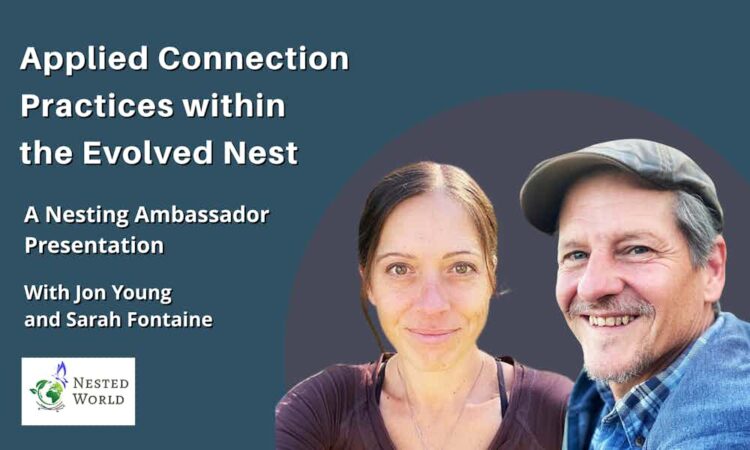
Another way to view Kinship Praxis is as skilled peacemaking. The steps below are from the Designing for Peace protocol developed by Jon Young, founder of the 8 Shields Institute and a Nesting Ambassador. Justine Collet, Nesting Ambassador (Belgium) and a student of Jon Young’s Deep Nature Connection, integrated these insights for the Nesting Ambassador Program.
Step 1: The Inner Work – Grief, Worldview Literacy, and Self-Awareness

- Deep Nature Connection Routines. Healing begins by reactivating our sensitivity. Nature Connection—an Evolved Nest component—is not merely “being outside.” It is grounding ourselves in the living world so our nervous systems can regulate before we attempt to co-regulate others. In Kinship Worldview, this is relational: we listen to the land, waters, and more-than-human relatives as kin. Regular routines of natural connection become Kinship Praxis that restores the shaped neurobiological web of belonging.
- Consciousness, Competence, and Co-Mentoring. We cannot walk this path alone. Co-mentoring—designating support, exchanging stories with permission, and practicing Anchoring when empathy becomes overwhelming—mirrors the Evolved Nest components of Responsive Relationships and Positive Touch. Kinship Praxis adds multi-entity listening: we practice hearing both human and non-human voices, cultivating the competence to hold complexity without collapsing into urgency.
- The Transformative Leader (Role Modeling). A transformative leader has completed the cycle: gone below the valley of adaptation, crossed the wall of pain, and entered the underworld of grief. From that depth, they retrieve a tool, a vision, or a way forward. In Nested Kinship, this passage through ceremony and deep listening yields heart-led action. Their mere existence demonstrates that despair is a passage toward personal and collective genius. They model efficiency, joy, positivity, and hope while remaining humble before mystery.
- Reframing Despair. When someone is in deep despair, the instinct is to comfort or minimize. Instead, the leader validates the pain as a powerful opportunity: “That’s great! Do you realize what an opportunity this is? This is the moment when your vision can be the strongest.” The guidance remains clear—sit in the forest, stay alone with it, sit before a fire, cry, talk, journal, make art or poetry—but do not stay too long in despair. The goal is to extract the archetypal gift from the pain and activate a vision. Kinship Praxis includes ceremony that honors the mystery of what is dying and what is being born, supporting ancestral continuity rather than personal isolation.
Step 2: Understanding Trauma and Healing through Nested Kinship
 Once we have touched our grief, we understand trauma as the disconnection that occurs inside us when needs are not met. Since trauma happens in relationship (or its absence), it must be healed in relationship. We cannot think our way out; we must feel our way out, supported by Evolved Nest components and Kinship Worldview practices:
- Collective Healing Practices. Aligning with Responsive Relationships and Social Support components of the Evolved Nest, we create co-regulating fields where nervous systems settle together. Kinship Praxis extends this to multi-entity co-regulation—human, animal, plant, and elemental relatives.
- Body-Based and Restorative Practices. Restorative Healing Practices (an early component in trauma-informed sequencing) and approaches that work through the body restore capacity. These are not techniques to fix others but invitations to presence.
- Nature as Co-therapist and Kin. Re-establishing our bond with the natural world provides a constant, non-judgmental regulator. In Kinship Worldview, Nature is not a resource or backdrop; it is relative. Nature Connection practices become living Kinship Praxis that reweaves the nest.
Step 3: The Peace Framework – Sharing as Kinship Praxis
How do we translate this inner work into conversation or storytelling? How do we share the Evolved Nest without triggering defensiveness? We use the Peace Agreements—structured around four axes and informed by Haudenosaunee relational wisdom—as Kinship Praxis. These axes align with Kinship Worldview principles of respect, reciprocity, and ceremony.
- The Peace Axis: Personal Peace (NE-SW)
Before we engage, we must be regulated. Personal peace is not the absence of chaos; it is the ability to find calm within it. This is Restorative Healing Practices and Nature Connection in action.
- Mind and Body: Mindfulness, sensory meditation, walking in nature, nutrition, rest, safety, and physical comfort.
- In Practice: Before a difficult conversation about parenting or societal conditions, check your own state. Are you anxious or angry? Take a moment for a five-senses practice or silence. You cannot co-regulate a child or an adult if you are dysregulated. Kinship Praxis asks us also to notice the more-than-human field around us as an ally in regulation.
- The Good Message Axis: Interpersonal Peace (E-W)
How we communicate determines if the message is received. This axis focuses on connection and trust—core to the Evolved Nest Components of Responsive Relationships and Positive Touch.
- Greetings & Orientation: Start with a check-in. Use circle processes where every voice is heard—human and, when appropriate, acknowledged non-human presence.
- Authentic Communication: Use “I-statements.” Separate emotional responses from the information needed.
- In Practice: When sharing the Evolved Nest, do not start with data or judgment. Start by honoring the other person’s story. Ask, “How are you feeling about your family’s rhythm right now?” Listen to their struggles without trying to fix them immediately. Create a space where they feel valued, not corrected. This is Kinship Praxis of deep listening.
- The Unity Axis: Collective Peace (N-S)
Creating a shared vision. This axis aligns the group toward a common purpose within Nested Kinship.
- Vision & Roles: Imagine everyone on a ship. Do we all know the destination? Do we know our roles?
- In Practice: Frame the Evolved Nest not as a critique of the individual, but as a shared mission for the community and the living world. “We all want our children—and the children of all our kin—to thrive. How can we support each other in creating more nature time and restorative rhythms?” Create clear, agreed-upon ways to achieve this, reducing the friction of ambiguity. Kinship Praxis shapes nurturance ecosystems together.
- The Healing Axis: Addressing the Shadow (NW-SE)
Acknowledging the past to free the future. If tensions rise despite good communication, it is often because of past wounds—personal or intergenerational—and the loss of kinship continuity.
- Inner Tracking: Encourage reflection on triggers. “Why does this topic make me so angry?”
- Safe Spaces: Create distinct times for operational work and times for emotional processing and ceremony.
- In Practice: If a discussion about screen time or discipline becomes heated, pause. Acknowledge that this touches deep wounds about how we were raised and the nests we did not receive. Normalize the difficulty. Say, “It makes sense that this feels hard; many of us didn’t receive this kind of care ourselves.” This validates their experience, lowers defenses, and opens space for repair—core to both trauma-informed practice and Kinship Worldview.
Step 4: Embodiment – Kinship Praxis as the Ultimate Teaching Tool

References
[1] Jon Young, transformative leadership and 8 Shields models.
[2] Peace Agreements drawn from the work of Jon Young with Haudenosaunee people.