
Gifts of Presence at the End of Life: A Salon Discussion with Judith Maeeryam Wouk and Paola Melchiori
A Maternal Gift Economy Salon

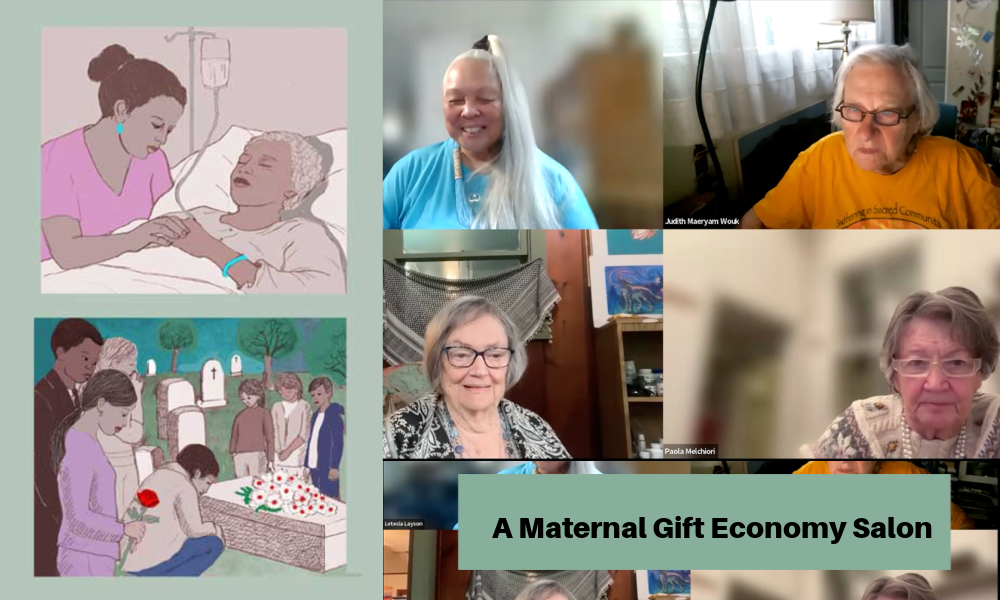
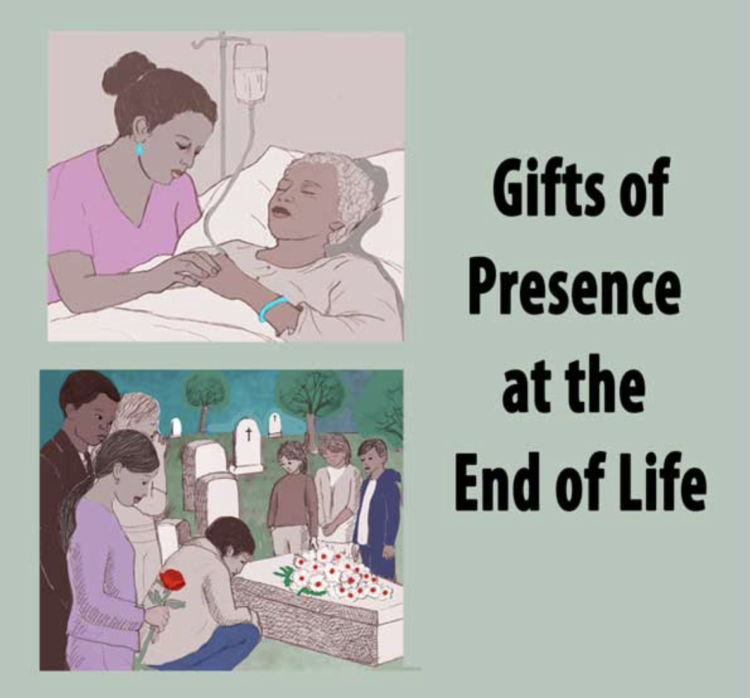 Editor’s Note: This year we added a tenth component to the Evolved Nest’s Nine Components: Death, Transition, and Ancestral Continuity. You can read an overview of the component that completes the continuum of the Lived Experience of the Evolved Nest, below. We are grateful to add this timely salon discussion from our nonprofit partners to our resources for the component. In the salon below, Letecia Layson (host) and Genevieve Vaughn (founder) of the Maternal Gift Economy discuss Gifts of Presence at the End of Life with Paola Melchiori and Judith Wouk. We are collecting resources to share in the new component. Please send your recommendations to us at nestedworldinitiative@gmail.com. And thank you to our nonprofit partners and soul sisters at the Maternal Gift Economy!
Save the Date: Darcia Narvaez will be presenting at the Annual Black Friday Mini-Conference “The Gifts of Truth and Courage” with Heide Gottner-Abendroth, Sabina Santovetti, the CoFounders of Motherful, Heidi Howes & Lisa Woodward. For more information on this event go here.
About the Speakers
Paola Melchiori
Paola Melchiori is a Feminist theorist , activist and writer, author of books/videos/articles on feminist issues. She has created nationally and internationally, free spaces of critical thinking, based on the model of the Free Universities. Their main idea is to develop and make visible new paradigms of knowledge based on women’s ways of thinking and knowing, working in an interdisciplinary way across cultures, classes and specializations. She is the founder and past president of The Women’s Free University in Milan, of Crinali, a research and intercultural education association in Milan, of the International Feminist University Network, an international think-tank for women’s critical thinking and education. From the mid eighties she has worked in different African and Latin American countries in women’s education, participatory research and popular education with a Freirian and feminist perspective. During the years of the UN Conferences of the 90ties she has formed a solid International network of feminists working together on these issues. Her main interest is the intercultural collaboration among feminists of different cultures and disciplines. She is the author of several essays on feminist theory, of four books, and of several videos.
Judith Maeeryam Wouk
Judith Wouk has been part of the Maternal Gift Economy Movement since it started. She is an ordained Kohenet Hebrew Priestess, chair of the Funeral Advisory and Memorial Society of Ontario (FAMS) and a member of Conservation Burial Ottawa. She lives in Ottawa, Canada. Her article “Women, Chevra Kadisha, and the Gift Economy” appears in Canadian Woman Studies/ les cahiers de la femme Volume 34 Numbers 1,2 fall/winter 2020, Feminist Gift Economy: Maternalist Alternative to Patriarchy and Capitalism.
Watch the Discussion: Gifts of Presence at the End of Life
About the New Death, Transition, and Ancestral Continuity Component of the Evolved Nest
Species-typical Shape (what the component is)
In nested form, dying is:
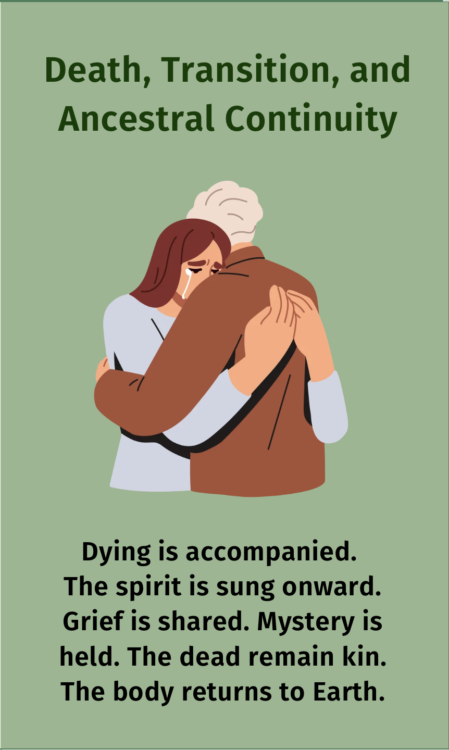
Expected and visible. Children grow up knowing that bodies fail, elders die, animals die, seasons turn. Death is not a secret adults keep from the young.
Accompanied. Multiple bonded people stay. No one is left alone with machines as the primary “caregivers.” Responsiveness continues: pain, fear, thirst, the need to be held, the need for quiet, the need for song.
Touched. Positive moving touch does not stop at the hospital door. Holding, stroking, presence of skin and breath remain part of regulation for the dying nervous system and for those keeping vigil.
Placed. Nature immersion is not optional scenery. Windows, earth, water, plants, animals, weather, and—when possible—dying or laying-out in a home still belonging to the living community. After death, the body is returned to land with reciprocity.
Ceremonial and playful in the old sense. Ritual, story, song, humor, and child presence (when appropriate) keep the social field from collapsing into sterile solemnity or denial. Ceremony is not decoration around a biological event. It helps the spirit move on. Indigenous cultures more often see death as *journeying* than as arriving. The person’s spirit is understood to be on its own passage—one the living can accompany, sing to, and support, but not chart or control. The work of the nest is companionship and sending, not mapping or managing the destination.
Mystery-keeping. The community does not fill the threshold with doctrine, prediction, or the demand to know. Unknowing is part of the nest: humility, song, silence, and trust sit where certainty cannot.
Grief-literate. The community has regular practices for keening, sitting, feeding mourners, speaking the name (or not, according to local custom), and metabolizing loss so it does not calcify into unprocessed trauma for the next generation.
Ancestral. The dead remain part of the welcoming social climate. They are spoken of, fed in ceremony, asked for help, included in decisions about land and children. Continuity is practiced, not merely believed.
The neurobiology is continuous with the rest of the nest. Isolation, unaccompanied pain, and terror of annihilation activate the same survival systems that early undercare builds. Presence, touch, familiar voices, ceremony, and a coherent stance of “you are still in the web, and we will not pretend to own your passage” keep the dying person—and the witnesses—inside a regulated social nervous system as far as the body allows. Science here describes accompaniment and regulation. It does not replace mystery with a map.