

Bio-Cultural Conflict as Moral Injury
The Bio-Cultural Conflict is the core issue addressed and redressed by scientists, researchers, public policy makers, professionals, practitioners and parent activists of the Conscious Parenting Movement over the past 50 years. The Bio-Cultural Conflict was defined by the godfather of the Conscious Parenting Movement, Joseph Chilton Pearce, whose lifetime of seminal works pointed to the socially-engineered chasm between our biological imperatives and our cultural imperatives. New parents especially find themselves trapped in this conflict with very few social net resources in America, who ranks at the bottom of all developed countries for maternal and infant health, paid parental leave, work place support for breastfeeding, and childcare. In 2024, the US Surgeon General issued an advisory on parent stress, naming it an urgent public health issue, highlighting that parents face overwhelming stress from financial strain, time demands, isolation, technology, and cultural pressures, leading to burnout. The advisory urges a cultural shift to value parents, calls for systemic support like paid leave and affordable childcare, and encourages parents to set boundaries and connect with others to protect their mental health and that of their children.
Kindred’s nonprofit mission is to Share the New Story of the Human Family by exploring and presenting the science of our evolutionary pathway to wellbeing, our Evolved Nest, and its resulting Kinship Worldview. As an alternative media outlet, Kindred presents the breakthroughs and success stories happening all around us, but are not recognized, appreciated or understood by mainstream media. We don’t know what the New Story would look like if we embraced and supported our biological imperatives, but we would like to imagine this possibility and find out, together.
Please support our nonprofit work with your tax-deductible donations.
Pearce’s Bio-Cultural Conflict
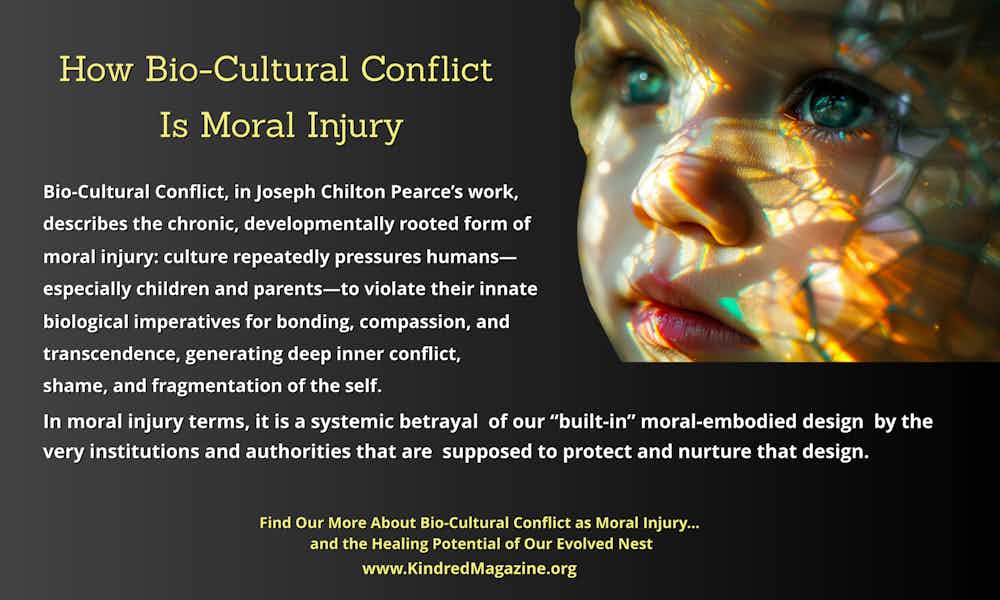
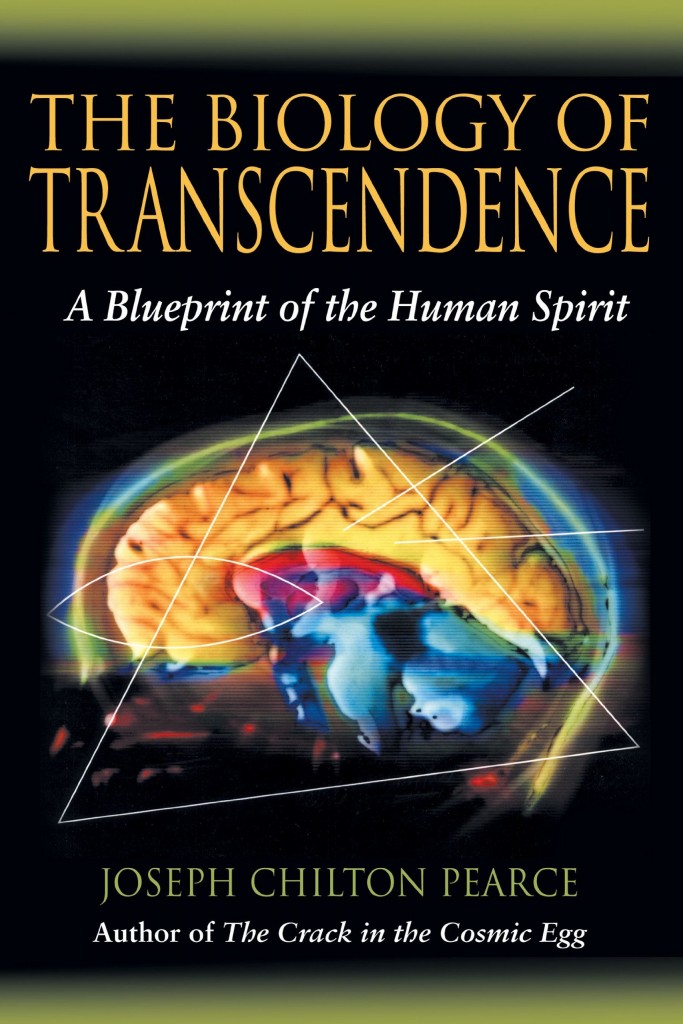
Bio-cultural conflict in Joseph Chilton Pearce’s work, and therefore Kindred World’s nonprofit vision and mission, can be understood as a chronic, developmentally rooted form of moral injury: culture repeatedly pressures humans—especially children and parents—to violate their innate biological imperatives for bonding, compassion, and transcendence, generating deep inner conflict, shame, and fragmentation of the self. In moral injury terms, it is a systemic betrayal of our “built‑in” moral-embodied design by the very institutions and authorities that are supposed to protect and nurture that design. Pearce’s book, The Biology of Transcendence is an exploration of the Bio-Cultural Conflict. (Read the introduction to the book on Kindred.)
Pearce describes a “biological imperative” toward bonding, heart–brain coherence, and transcendence—an intrinsic drive for open attachment, empathy, and expanding consciousness across development. Against this, a “cultural imperative” demands conformity to practices that block or distort this design, such as technologized birth, detached caregiving, and competitive, factory‑model schooling that override the child’s innate expectations.
This clash is what Pearce and his interpreters call the bio-cultural conflict: the living organism is organized for one pattern of relationship, while the surrounding culture enforces another that is fundamentally mis-attuned to our neurobiological template. Over time, this conflict becomes embodied as stress, defensive adaptations, and the loss of “unconflicted behavior,” where heart and mind would otherwise function in synchrony.
Moral injury: Key Elements
In contemporary psychology, moral injury involves exposure to events or systems in which a person perpetrates, witnesses, or is subjected to actions that violate deeply held moral or relational expectations, especially when trusted authorities are involved. Core features include a felt betrayal of what is right, persistent shame or guilt, and a fracture in one’s sense of self and meaning, even when the individual is not “at fault” in any ordinary sense.
Moral injury also often arises not from a single event but from ongoing participation in structures that repeatedly pressure the person to act against their moral intuition, such as institutional routines that normalize harm, neglect, or dehumanization. The result is an inner split between what the person’s conscience or body knows to be true and what they feel forced to enact or accept.
How Bio-Cultural Conflict Maps onto Moral Injury
Pearce’s account of culture “hijacking” our neurobiology—through practices that break early bonding, suppress empathy, and normalize violence or indifference—matches the pattern of a systemic, lifelong moral injury beginning in infancy. The infant’s and child’s “moral expectations” are biologically embodied: they assume responsive care, secure attachment, and a trustworthy larger field of support, and when culture violates these assumptions, the organism experiences a deep betrayal by its surround.
Because these violations are carried out by parents, professionals, and institutions acting under cultural imperatives, the child cannot identify a clear perpetrator and instead turns the conflict inward as self-blame or dissociation, which Pearce describes as a splitting of self and a loss of authentic intelligence. In this sense, Bio-Cultural Conflict is a form of Moral Injury in which the “injurer” is an entire misaligned cultural system, and the “injury” is a chronic rupture between our biological/spiritual design and the roles we are forced to inhabit.
Consequences for Self and Society
Pearce links this unresolved conflict to pervasive violence—toward self, others, and the Earth—arguing that blocked transcendence and broken bonding turn our frustrated biological energies outward as aggression or numbness. From a moral injury lens, these are the downstream expressions of a wounded conscience and a fragmented identity: people act destructively not only out of “badness” but out of a long history of having their innate moral-embodied capacities betrayed and suppressed.
He also emphasizes that restoration is possible through re-establishing unconflicted heart–mind coherence and nurturing cultures that align with our biological imperative, such as practices that honor secure bonding, responsive parenting, and authentic spiritual development. Framed this way, healing bio-cultural conflict and healing moral injury both require relational repair, trustworthy community, and structures that stop asking people—especially children—to violate the deepest truths of their own bodies and hearts.
How the Evolved Nest Heals the Bio-Cultural Conflict
The Evolved Nest heals Bio-Cultural Conflict by restoring the species-normal conditions that align a child’s (and community’s) neurobiology with its lived environment, so biology and culture stop “fighting” each other and begin working in synchrony again. In doing so, it reduces trauma and moral injury by meeting innate expectations for care, belonging, cooperation, and ongoing relational repair.
![]() Realigning Biology and Culture
Realigning Biology and Culture
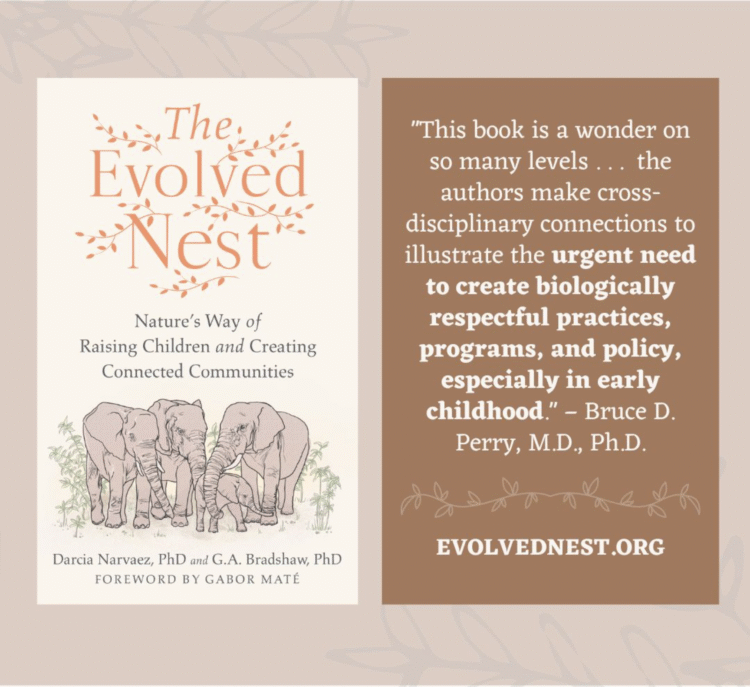
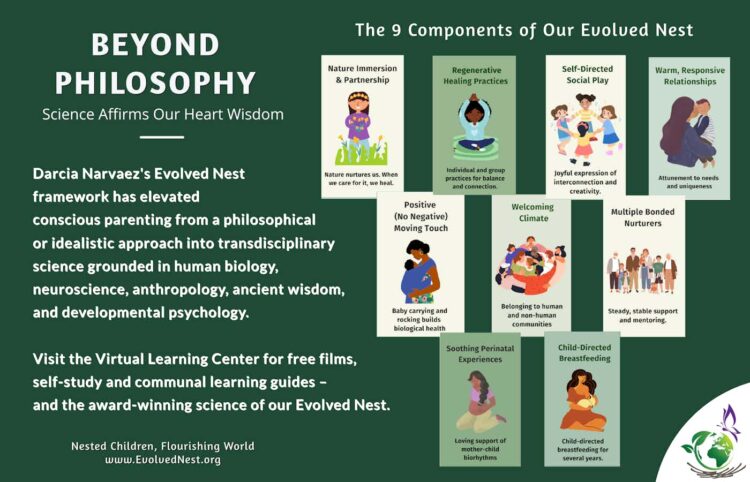
Darcia Narvaez, Kindred World’s president, describes the Evolved Nest (or evolved developmental niche) as the set of caregiving and community practices humans adapted to over millions of years: soothing perinatal experience, extended breastfeeding, responsive care, multiple stable caregivers, affectionate touch, free social play, nature immersion, and routine healing practices. These components create a culture that matches our biological “blueprint,” reversing the undercare and fear-conditioning that characterize colonized, industrial childrearing.
When these elements are present, children develop “species-normal nestedness”: their nervous systems, emotions, and moral orientations are shaped by consistent experiences of safety, reciprocity, and connection. This reduces the internalized split between what the body expects (cooperative attachment, shared flourishing) and what daily life delivers, directly easing the bio-cultural conflict identified by Pearce.
Buffering Trauma and Moral Injury
Empirical work on the Evolved Nest shows that higher “EDN-history” (more nest experience in childhood) is associated with better physiological regulation and psychological resilience, and it can buffer the negative effects of adversity and trauma. Put differently, when the nest is provided, stressors are less likely to embed as chronic, dysregulating wounds that drive defensive, fear-based behavior.
Because moral injury involves enduring psychological, biological, and spiritual impacts from violations of deeply held moral expectations, the Evolved Nest functions both preventively and reparatively: it reduces the frequency of those violations in everyday caregiving and offers ongoing routines for healing when harm does occur. Routine healing practices in nest-supportive communities normalize confession, repair, co-regulation, and ritualized re-centering, which help integrate painful experiences instead of leaving them as unprocessed bio-cultural ruptures.
Restoring Cooperative, Kinship-based Worldviews
Narvaez explicitly contrasts the Evolved Nest with settler-colonial, domination-based childrearing that disconnects people from land, community, and their own embodied wisdom. By re-establishing nested, cooperative lifeways similar to small-band, hunter-gatherer and Indigenous kinship cultures, the nest reorients development toward “spiritual heartmindedness,” ecological attachment, and gift-based reciprocity—precisely the capacities undermined by modern bio-cultural conflict.
Adults raised or re-nested in this way show quieter minds, emotional presence, inner joy, empathy, authenticity, and a tendency to build thriving, prosocial communities. In Pearce’s terms, this is the restoration of “unconflicted behavior”—heart and mind rejoined in service of life—so that culture once again confirms, instead of betrays, our biological and moral design.
« Back to Glossary Index
Comments are closed.