

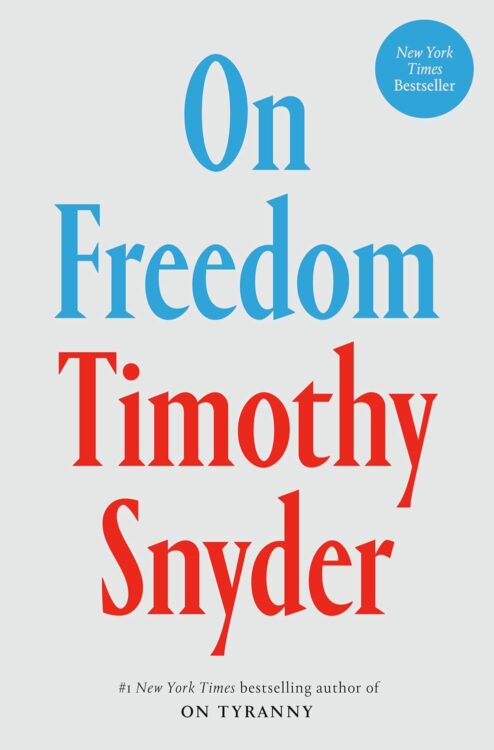
In his book, On Freedom, Timothy Snyder identifies five forms of freedom. The five forms include the capacities to evaluate and change the world (sovereignty or autonomy); the capacity to make choices (unpredictability); the ability to move through time and space following one’s values (mobility); a fact-based apprehension of the world that allows for effective action (factuality); and understanding that freedom is for everyone (solidarity).
Snyder adheres each form of freedom to different stages of life: childhood builds sovereignty; youth builds unpredictability; young adulthood builds mobility. Both factuality and solidarity enable the others and are mature forms of freedom.
I would say, it depends. How and whether these freedom capacities are evident depends on the nurturing provided in early life as well as at each stage. These depend on intergenerational support, our communal evolved nest.
 SOVEREIGNTY: Evaluating the world and being able to change it accompanied by others.
When our parents and grandparents and other nurturers are well embodied (well-functioning neurobiology from their nurturing upbringing), they bring us into ourselves, letting our unique self and gifts unfold. Ubuntu: I am because we are. Democratic character starts in babyhood.
UNPREDICTABILITY: the capacity to make choices.
This entails free will. But our free will can be thwarted by threat reactivity, which shift blood flow from higher order thinking to muscles for flight or fight, making us stupid (Robert Sapolsky’s insight). Threat reactivity is fostered by extensive distress in babyhood, altering brain structures the person carries forward. The individual learns to brace against life instead of embracing its ongoing dynamism.
MOBILITY: the ability to move through time and space following one’s values.
This assumes that one knows what one’s values are. But if a person grows up in an authoritarian household and community, such as one governed by “Biblical parenting,” then others’ values have been foisted on them. They are externally focused on what others want and value instead of on following their inner moral compass (in religious terms, following their divine spark).
FACTUALITY: a fact-based apprehension of the world that allows for effective action.
Unfortunately, too many children grow up in highly stressed families where they are told that they are loved while being treated in the opposite manner. So they may develop anxious attachment and learn to manipulate others to get their unmet early needs slightly met. Not surprisingly, anxious attachment is associated with low trust in cognition. They will be susceptible to misinformation, since they grew up being discouraged from thinking very deeply.
SOLIDARITY: understanding that freedom is for everyone.
A baby who grows up with minimal care (which the dominant culture forces on families) will have deficit needs for attention, will feel that the world is one of scarcity, and will be drawn to hoarding resources for the self. They will be dysregulated one way or another. Adults may conclude they need to be punished so they grow into community membership. In this case, freedom is only for following what the adult culture wants. This longstanding western culture worldview of how to raise children is contradicted by Indigenous ways.
In the industrialized, machine-minded, capitalistic society, people are neglectfully treated as objects rather than as living organisms. In early childhood, if we are treated as objects, as “its” rather than “thous,” we will learn to do the same to others. We will view ourselves as objects and be manipulatable by those who treat us like objects. We will be raised with a biology of fear and self-protectionism rather than a biology of love and openness.
The biology of fear affects all the freedoms. Our sovereignty will be impaired because our fullness will not be cultivated. Our unpredictability will be limited to the inconsequential things allowed, like choosing a red or blue balloon, which cereal to eat, whether to follow the external, unfelt rule or not. Our mobility will be hampered by our fear of the world. Factuality will be warped by the ideologies with which we were raised or are attracted to from the paranoia we develop when isolated. Because of our fearfulness, our sense of solidarity will be oriented only to our ingroup, or no one at all.
We will be attracted to “freedom froms” –from “those” people, activities, cultures that are unfamiliar and make us uncomfortable or anxious. We prefer to brace against the world instead of building personal knowledge and skills from our own interactions with the new and unfamiliar.
I wish to underscore Snyder’s point: “The [five forms of freedom] create a world where people act on the basis of values. They are not rules or orders. They are the logical, moral, and political links between common action and the formation of free individuals. The forms resolve two apparent conundrums: a free person is an individual, but no one becomes an individual alone; freedom is felt in one lifetime, but it must be the work of generations” (p. xvii).
For a host of converging factors over the last fifty years in particular, the USA has neglected to grow the freedoms of its young in the ways noted above. The culture has eroded our freedoms across generations because growing human nature and its freedoms is a communal, intergenerational endeavor but we’ve put the burden on moms and families, with next to no support.
“Freedom requires a positive presence” (p. 66). What does that mean?
We are all responsible for bringing up the next generations with the five freedoms. Our species’ communal evolved nest supports the freedoms: multiple stable nurturers provide the 24/7 welcoming affectionate touch and comforting care needed in babyhood (first 1000 days or so). Throughout childhood the community allows the child’s uniqueness to grow freely in Nature through whole-body free play with multi-aged mates. We encourage and welcome the children we meet. We encourage one another in the five freedoms.
And we remember, freedom starts with babies.
References
Arnsten, A.F.T. (1998) The Biology of Being Frazzled. Science, 280(5370), 1711-1712.
Arnsten, A.F.T. (2009). Stress signaling pathways that impair prefrontal cortex structure and function. Nature Reviews Neuroscience, 10(6), 410-422. https://doi.org/10.1038/nrn2648
Bourgeault, C. (2003). The wisdom way of knowing: Reclaiming an ancient tradition to awaken the heart. San Francisco, CA: Jossey-Bass.
Maturana, H. R., & Verden-Zöller, G. (2008). The origin of humanness in the biology of love. Imprint Academic.
Narvaez, D. (2014). Neurobiology and the development of human morality: Evolution, culture and wisdom. Norton.
Sapolsky, R. M. (2004). Why zebras don’t get ulcers (3rd ed.). New York: Holt.
Schore, A.N. (2025). The right brain and the origin of human nature. W.W. Norton.
Snyder, T. (2024). On freedom. Crown.
Topa, W. (Four Arrows), & Narvaez, D. (2022). Restoring the kinship worldview: Indigenous voices introduce 28 precepts for rebalancing life on planet earth. North Atlantic Books.
Van der Kolk, B. (2014). The body keeps the score. New York: Penguin.